

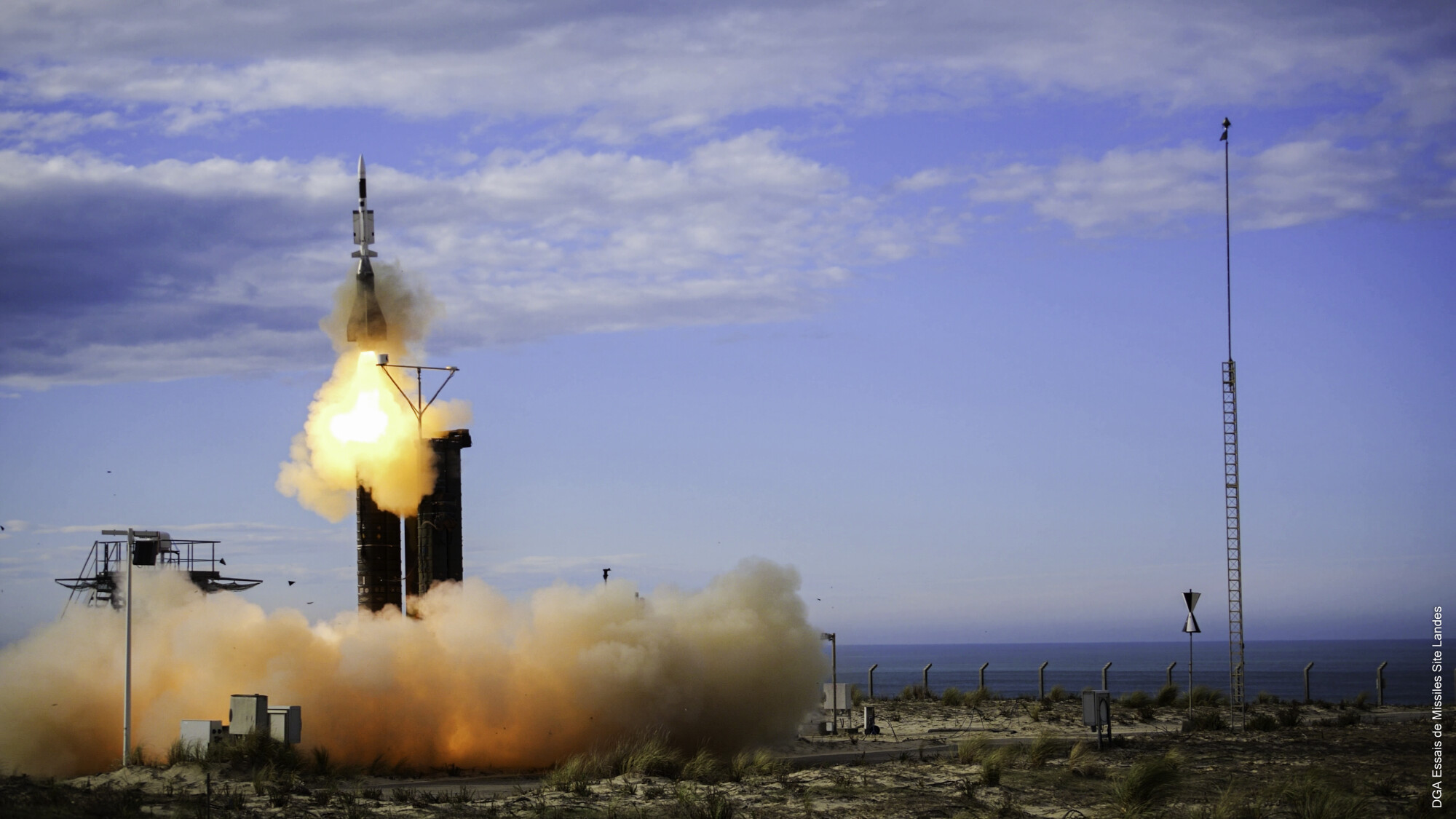
SAMP/T NG Successfully Fired
TWO successful firings of the SAMP/T New Generation (SAMP/T NG) were performed in France and Italy, demonstrating once more the high level of performance of this long-range capability developed by eurosam comprising Thales and MBDA for the armed forces of the two nations in the frame of the historical trilateral Air Defence FSAF-PAAMS cooperation managed by OCCAR (Organisation for Joint Armament Co-operation) on behalf of France, Italy and the UK.
These firings were held at PISQ (Poligono Interforze del Salto di Quirra) test range, in Sardinia, on December 3 with a SAMP/T NG Italian variant and at DGA Essais de Missiles test range, at Biscarrosse, on Dec 15 with a SAMP/T NG French variant.
Following previous successful firings of MBDA ASTER B1NT missiles in October 2024 and July 2025 which validated the long-range capability, these two new firings in full new generation system configuration (Engagement Module, sensor radar, launchers interconnected) demonstrate the enhanced operational capabilities of the SAMP/T NG long range air defence system which will allow to intercept challenging aerial and missiles targets in terms of range, manoeuvrability, furtivity or speed.
These firings are a great achievement for the bilateral SAMP/T NG programme managed by OCCAR on behalf of France and Italy. Thanks to the dedication and professionalism of eurosam, MBDA and Thales teams, OCCAR, and experts from the two Nations, particularly from French DGA and Italian DNA, these successes are important steps forward in the development of this new cutting-edge European Air Defence asset.
SAMP/T NG has already been ordered to equip the French and Italian air and space forces as well as the Italian army. The first systems will be delivered to the French Air and Space Force (FASF), the Italian Army in early 2026 for operational evaluation. In September 2025, Denmark selected the French variant of SAMP/T NG to provide the country with a state-of-the-art solution for its long-range surface-based air and missile defence.

In a related development, Leonardo will develop and deliver the first four Italian next generation radars for long range ballistic defence. Taking a major step forward in the development and implementation of the Michelangelo Dome advanced integrated defence system technology enablers, Leonardo signed a contract with Italian TELEDIFE (Direzione Informatica Telematica e Tecnologie Avanzate) for the development and delivery of four next generation radars, designed to counter long range ballistic threats (3,000 km).
This signing sets a second milestone for the Michelangelo Dome advanced integrated defence system since its official unveiling in November. The contract follows the successful first qualification launch of the Italian SAMP/T NG Surface-to-Air Missile system, carried out in early December, equipped with Leonardo’s latest-generation KRONOS Grand Mobile High Power Radar Sensor.
The contract includes the supply of the Ground Based Radar (GBR) and the Mobile Long Range Radar (MLRR). These systems feature fully digital AESA GaN (Active Electronically Scanned Array – Gallium Nitride) technology, allowing high efficiency and extended detection range, and able to deliver advanced surveillance and early warning, accurate identification and timely tracking, enabling real time tactical picture update and effectively cueing Fire Control Radars (FCR) and the relevant effectors, according to the open architecture and asset integration versatility in multidomain scenarios, consistent with the Michelangelo Dome’s design and operational philosophy.
These characteristics, combined with other advanced capabilities, make the new radars one of the effective measures to meet the integrated ballistic defence requirements, positioning this technology at the top of European advanced radar sensor capabilities. With this programme, Italy is the first European country featuring national integrated air and missile defence capabilities to counter new long range threats.