

Malaysia Launches National Defence Industry Policy
MALAYSIA launched the National Defence Industry Policy, a long-term strategic plan which aims to reduce the country’s reliance on foreign parties for defence and security matters as well as build up the self-sustainability and resilience of the national defence industry.
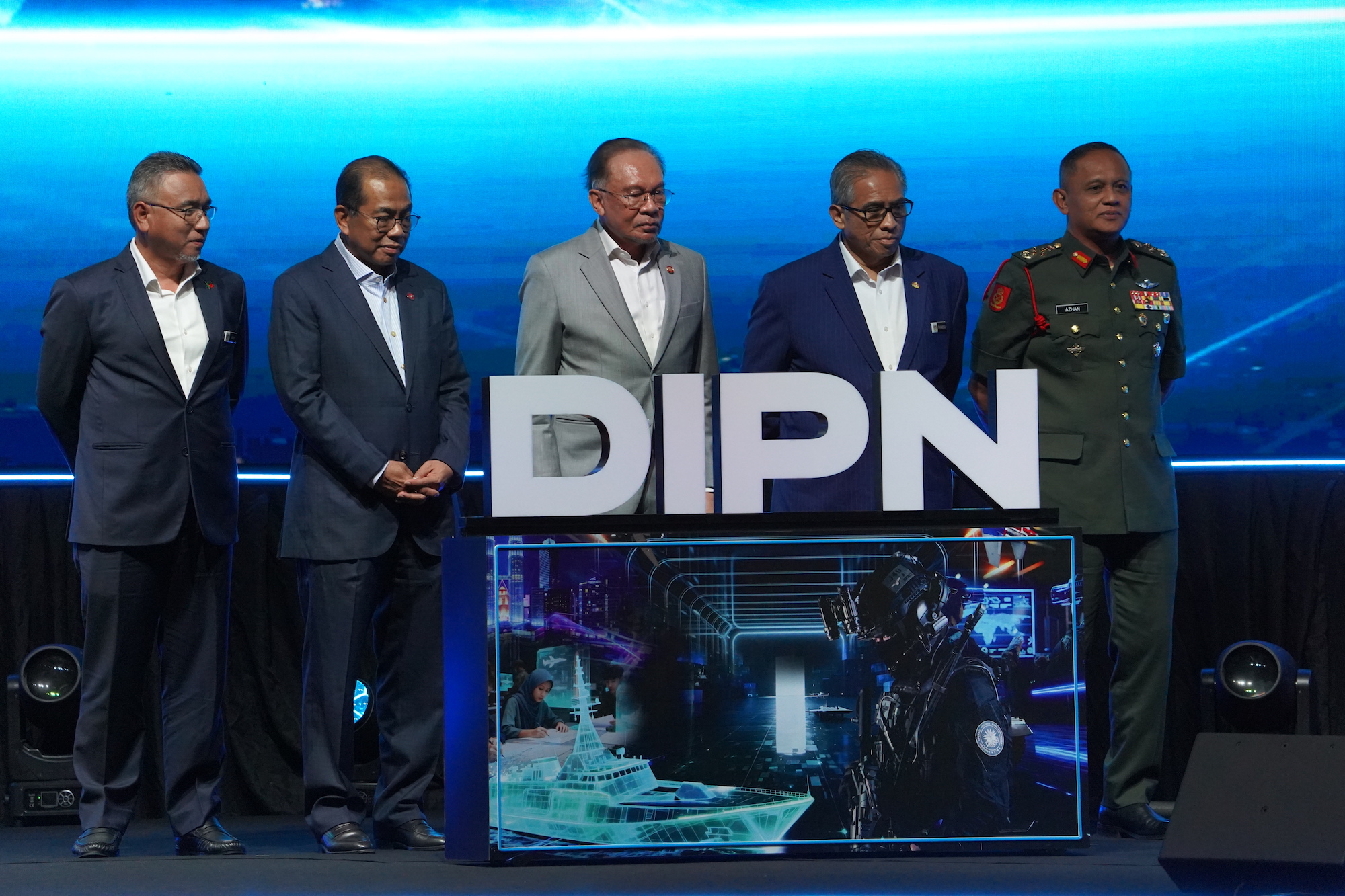
Officiating the launch was the prime minister Anwar Ibrahim together with the defence minister Khaled Nordin, deputy defence minister Adly Zahari and the Chief of Army General Azhan Md Othman representing the Royal Malaysian Navy (RMN) chief Admiral Zulhelmy Ithnain who is currently the acting Chief of Defence Force (CDF).
The prime minister said, the long-delayed policy is now being implemented in line with the demands of the times and the current needs of the Malaysian Armed Forces (MAF). “This defence industry policy has indeed been long-delayed and I think it is in line with the demands of the times and hopefully overcomes the crisis that has befallen the MAF recently.’
He added that the four main pillars driving the NDIP encompasses the strengthening of governance and institutions, development of technological capabilities, the reinforcement of the ecosystem and local defence supply chain followed by the increase of global competitiveness and exports.
Adding on, the defence minister said that the increasingly complex, fragile and uncertain global security landscape required Malaysia to strengthen its defence capabilities through the development of a strong and competitive domestic industry. Saying “it would be a great loss if the high allocation channelled to the Ministry of Defence every year was not fully utilised to develop the country’s defence industry that can stand on its own capabilities’.
He also stressed that the NDIP’s success hinges on building a comprehensive ecosystem, comprehensive government commitment, reforms of defence procurement policies and the effective transfer of technology which contributes to improved research and development (R&D).
Among the reforms of procurement practice will now require a minimum of 30% indigenous content and that the maintenance, repair and overhaul (MRO) works have to be conducted by local firms after warranty periods are no longer handled by the original equipment manufacturers (OEM).
Aside from that, the Defence Industry Portal was also introduced which will serve as a one-stop information hub and bring together government agencies, local industry platers and strategic partners.
The DIPN also outlines six strategic objectives–to attract further investment, increase innovation in sovereign technology, strengthen the local supply chain, hone local skilled workforces and develop talent, ensure transparency in management, and spur economic growth.
Phase 1(2025-2026) of the NDIP will see the building of foundations and development of policies followed the second phase (2026-2027) that looks to strengthen the local industry and technological advancements. Then, the third phase (2028-2029) encompasses the expansion of capabilities and readiness of the Malaysian defence industry before the fourth phase (2030 and beyond) which lays the eventual full capacity and global competitiveness.
Just last week, Malaysia had frozen all military and police procurement programmes that were plagued by graft with the arrest of the former Army chief and various other individuals, looking to stamp out the problem before putting the programmes back on track.
“How can we possibly establish a defence policy and procure the best weapons if we are still driven by personal gain, commissions and accumulated wealth Therefore, this freeze will continue in the Defence Ministry, and I also want to coordinate it with the Home Ministry”, Anwar said.
“I am not here to decide the types of weapons and equipment required in sequence within our limitations. The end-user will determine them, and we carry it out through a transparent and reasonable process, which I believe can be achieved once the new leadership of the armed forces is in place. I will provide full support, including for the DIPN. That is my assurance. The entire Cabinet stands together to restore and strengthen capabilities and also implement the DIPN.
In light of that, the defence ministry reiterated their focus on continuing national defence operations. “The ministry understands the government’s need for transparency and accountability, but the aspect of defence preparedness cannot be compromised. If the freeze directly affects the MAF’s capabilities, we will submit a specific application for the government’s consideration,” Khaled said.
This April 20-23, Kuala Lumpur’s Malaysia International Trade and Exhibition Centre (MITEC) will host the 19th Defence Services Asia 2026 and the fourth edition of National Security Asia 2026 (DSA & NATSEC Asia 2026). The event will bring together global defence powerhouses and the best of Malaysia’s now-growing local defence industry as well as foreign delegations.
Also announced were seven national defence projects, including the development of satellites to replace use of contract services that are expiring by 2029, laser anti-drone defence systems, assembly and manufacture of vehicle chassis, production of various weapon systems, passive radars, loitering munition systems and military training simulators.
The seven strategic projects outlined are:
-National Defence Satellite Service Project
The Ministry of Defence, through Boustead Holdings, is implementing a pilot project for the national defence satellite service. This project aims to develop local capabilities in satellite software mastery, spectrum management, and satellite operations maintenance, enabling Malaysia to independently operate defence satellite assets. This strengthens operational readiness while reducing reliance on foreign technical support.
-Development of a Laser-Based Air Defence System (Directed Energy Weapon – DEW)
Malaysia is developing a high‑energy laser Directed Energy Weapon system in collaboration with a company from China to enhance the tactical air defence capabilities of the Malaysian Armed Forces (MAF), particularly against asymmetric threats and the growing use of unmanned systems.
Through strategic cooperation, technology transfer, specialist training, and continuous research, this project builds national capability in DEW technology and reduces dependence on foreign systems.
-Development of a Wheeled Chassis Platform for Future Land Mobility Assets
Boustead Holdings, in collaboration with Turkiye’s Otokar is developing assembly and manufacturing capabilities for wheeled chassis platforms to support the future land mobility assets of the MAF. This cooperation focuses on transferring design, engineering, and manufacturing knowledge to strengthen the local defence vehicle industry and enhance domestic companies’ ability to support MAF operations.
-Development of Assembly, Repair, and Manufacturing Capabilities for Weapon Systems
Through cooperation between Boustead Holdings and Indonesia’s Komodo Armament, Malaysia is developing in‑country capabilities for the assembly, repair, and manufacturing of various small-arms. This project includes technology transfer, specialist training, and the development of production and maintenance capacity to support next‑generation weapon systems in a more structured and sustainable manner.
-Development of a Passive Electronic Intelligence System (Passive ELINT)
The TEDUNG system, developed by Mindmatics, is a passive radar system capable of detecting, identifying, and tracking radar and communication emissions with high‑precision 360‑degree coverage. The development of this locally produced system demonstrates the capability of the national defence industry in creating critical technologies, supporting land, sea, and air defence operations, early warning systems, and national electronic warfare.
-Development of Local Kamikaze Drones (Loitering Munition Systems)
Malaysia is developing locally produced Loitering Munition Systems through local firm Tinjau Mahir. These systems can loiter, verify targets in real time, and strike rapidly—ideal for MAF tactical operations with minimal risk to friendly forces—while building a cost‑effective and sustainable national defence supply chain.
-Development of the FA‑50M Flight Simulator for the Royal Malaysian Air Force (RMAF)
Through the Industrial Collaboration Programme (ICP) under the FA‑50M fighter aircraft procurement, local company Ikramatic Systems has developed the FA‑50M Flight Simulator for the RMAF.
This project represents a strategic investment in training and human capital development, enabling pilots to undergo realistic, safe, and repeatable training while strengthening local expertise in simulation and training support for strategic defence assets.