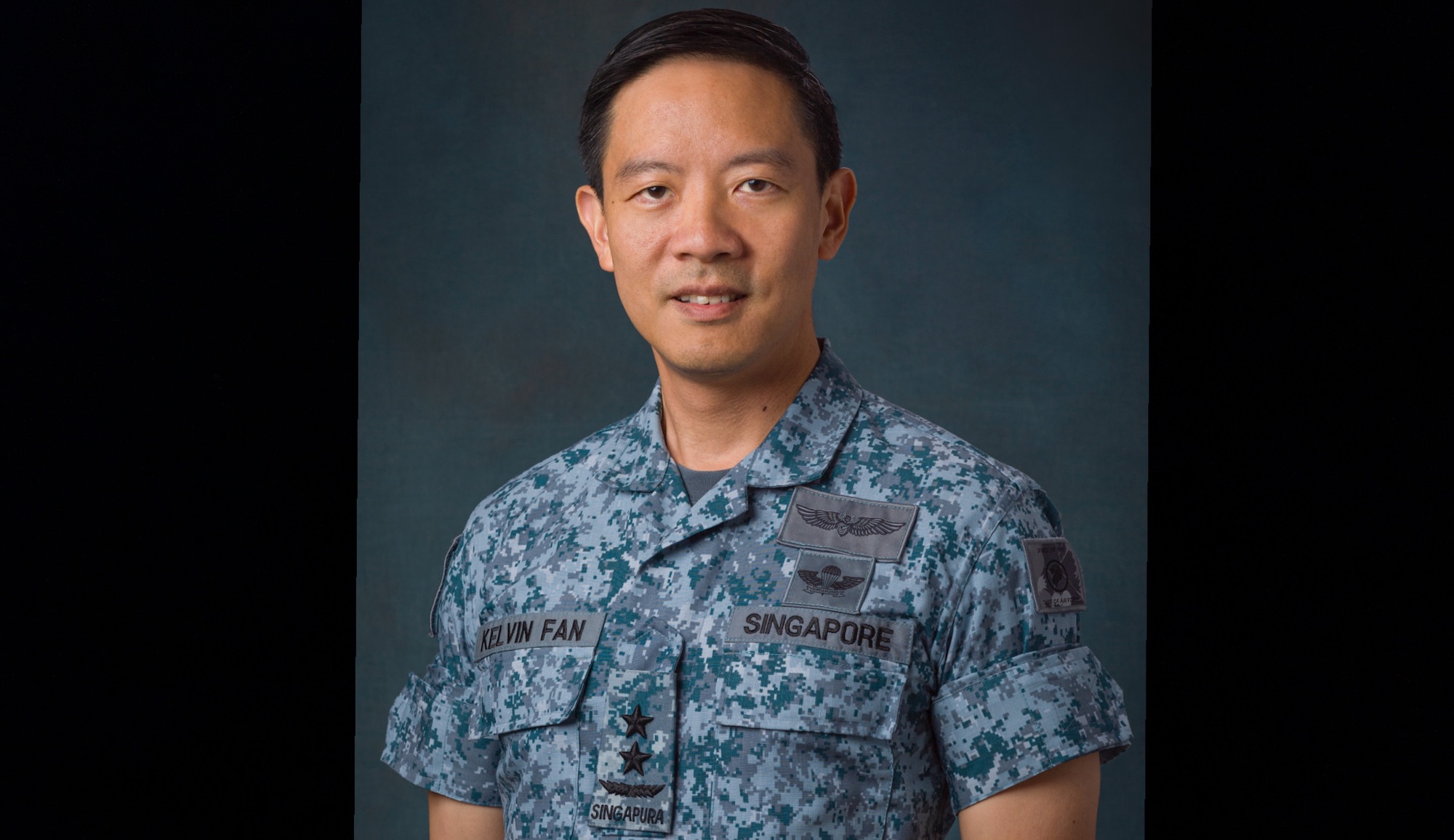
Major General Kelvin Fan, Chief of Republic of Singapore Air Force
THE RSAF Chief Major General Kelvin Fan recently spoke to the Asian Defence Journal on his priorities, reflections on conflicts, and thoughts on transformation of the force under his leadership.
ADJ: General, could you shed some light on your aspirations and focus for the RSAF since your appointment as service chief in March 2024?
CAF: First off, I am grateful to our airmen and women, past and present, who have built an Air Force that have kept Singapore’s skies safe. Since taking over as CAF, my priorities have been to learn from recent global conflicts and build a Ready, Relevant, Resilient and Respected Air Force. One that can deter, defend and, if threatened, dominate the skies.
A force that is:
– Ready to safeguard Singapore’s skies, save lives and serve Singaporeans.
– Relevant through force modernisation, drone and counter-drone warfare, and digital transformation.
-Resilient through smart airbases, diversified supply chains and innovative people.
– Respected through quality engagements and partnerships locally and internationally.
The strength of the RSAF comes from the respect, credibility and trust that we get from our internal tribe, domestic population and international partners. We earn our respect by doing our mission well and engaging the community. One notable development is our Building Engagement, Affection and Community Outreach Network (BEACON) movement. Our BEACON ambassadors partnered and engaged over 60 schools last year. This year, we aim to reach over 100 schools. I’ve engaged with the schools before and there is a strong sense of purpose, especially when we share about what we do in our alma mater or kids’ schools.
The RSAF’s success is built on the strength and capability of our people, and we must navigate the realities of a shrinking workforce and rising aspirations to continue to attract and retain talent.
The RSAF has had safety as our core value for decades, and we are continuing to look ahead to strengthen our safety culture and systems. We have strengthened partnerships locally and internationally to learn, exchange and benchmark our safety system. We have embarked on leveraging data science and artificial intelligence to enhance safety reporting, education, trend analysis and to enable proactive safety interventions.
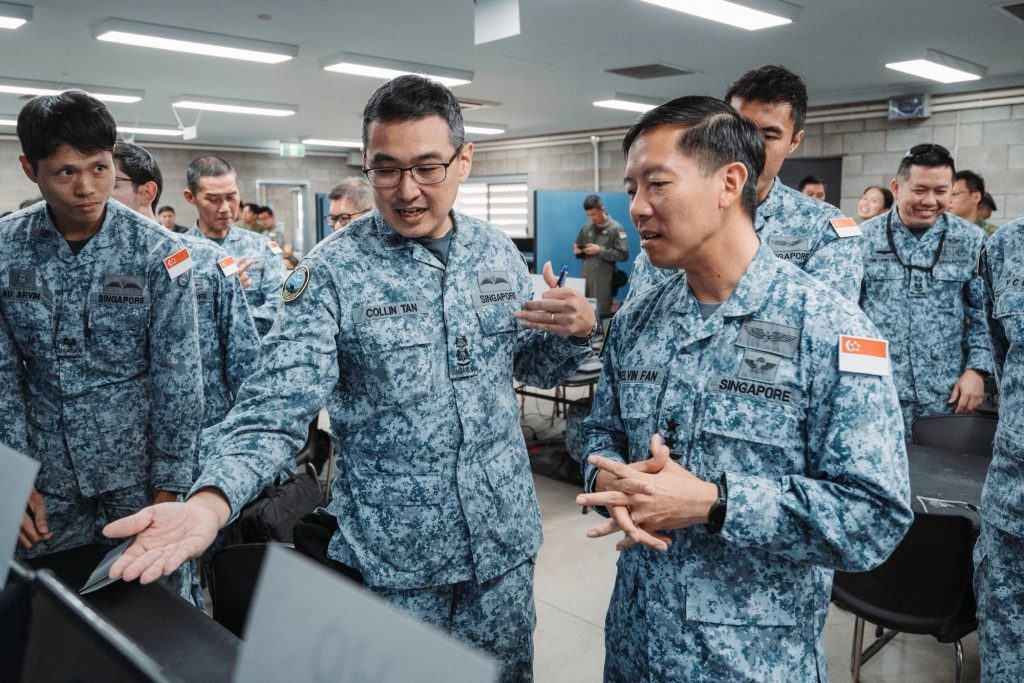
ADJ: What are some of the challenges currently facing the RSAF in this day and age as well as how it is responding to said challenges?
CAF: Our mission is to deter and be operationally ready. We live in relative peace but not absolute peace. World events have shown how quickly peace can disappear. Twenty-four-seven air defence is a key task for us. Our detailed operations cannot be shared freely but an incident I can talk about was in Oct 2024 when our team of aircrew, air defenders, controllers and ground crew responded within minutes to a bomb threat onboard a civilian aircraft, which we safely escorted to land in Changi airport.
We demonstrate readiness through participating in Humanitarian Assistance and Disaster Relief (HADR) and Search and Rescue (SAR) missions. In the last two years, we have conducted about 10 HADR missions including airdrops in Gaza, flood relief efforts support in Australia and humanitarian aid deliveries to Laos, Myanmar, the Philippines, Thailand and Vietnam. Our H225M Rescue 10 Helicopter has also conducted more than 10 lifesaving missions.
We hone our readiness by training hard and exercising with partners. We quip that “the sun never sets on the RSAF” because we train all around the world. Over 50% of our flying training is done overseas. Our people are internationally exposed and benchmarked. Defence diplomacy is important and I am thankful to many of the participating Air Forces in SA26 for their longstanding partnership, the joint exercises and the training access that they provide in their countries.
A new priority is to strengthen our resiliency so that we can achieve our mission even under disruption and degradation, as well as continuously learn and emerge stronger. For now, we are focusing on smart airbases, diversified supply chains and innovative people.
First, we are enhancing our Tengah Air Base and Changi Air Base with smart digital capabilities, unmanned vehicles, robust infrastructure and upgraded defence systems. This will make each airbase more effective and resilient for operations, as well as improve the working experience for our people.
Second, we are diversifying our supply chains and capabilities to better withstand disruptions. Beyond building strong partnerships with our vendors, this also entails a high-low mix of platforms, complementary kinetic and non-kinetic effectors, as well as an optimised mix of manned and unmanned aircraft.
Third, we believe that we need innovative people who can adapt to changing conditions and have the grit to overcome challenges.
ADJ: Several recent aerial battles and skirmishes in real-world conflicts were witnessed and studied by air forces around the world – what lessons have the RSAF taken note of from those engagements?
CAF: The recent conflicts are real-world universities, with many lessons but also noise. We must be discerning and learn the right lessons. It would be irresponsible to just blindly follow the buzzy terms, newest technologies or newspaper headlines. A lesson from the Russia-Ukraine conflict is that Air Forces must now build up drone and counter-drone capabilities. However, the more relevant lesson is that Singapore must avoid such a protracted attrition-based conflict at all costs. Couple this with the learnings from Israel-Iran and India-Pakistan, and my key takeaway is that the basics of Air Power, Air Superiority and Air Defence remain critical for Singapore to achieve its strategic objectives and avoid a protracted conflict. Thus, our RSAF 2040 transformation aims to build a future-ready and relevant Air Force that can deter, defend and, if threatened, dominate the skies.
Drones will play a much bigger role in the RSAF. We are no stranger to drones, having used them for almost 40 years. The key shift is the expanded scale and roles that drones will play. We are currently operationalising the Orbiter 4 and Hermes 900 UAVs. Our Air Warfare Centre and the new Drone Rapid Operational, Integration and Deployment (DROID) unit are experimenting, modifying and operationalising smaller drones for specialised missions. Our Plans department is studying the value of unmanned collaborative combat aircraft.
Additionally, we are partnering with relevant stakeholders such as institutes of higher learning (IHLs) and technology agencies, to build autonomous and manned-unmanned teaming capabilities. For example, in March 2025, the RSAF and DSTA initiated a partnership with Shield AI to harness AI and autonomy for more effective and resilient flight operations, and completed a flight demonstration in September 2025. Additionally, we teamed up with DSTA and Anduril Industries last March, and with Airbus Helicopters last June to explore how Manned-Unmanned Teaming (MUM-T) concepts can heighten situational awareness and enhance responsiveness. To really push this, we have restructured UAV Command (UC) to operationalise the next generation of drones and MUM-T concepts.
Just as we harness the potential of drones, we are also developing the counter-drone shield, especially against low-cost and swarm attacks. This is a key challenge because technology has given the attacker more advantages. But, just as how DSTA and RSAF built our 3rd Generation integrated air defence system, we will now need to innovate and strengthen our air defences with cost-effective capabilities such as non-kinetic systems, low-cost interceptors and counter-drone systems.
ADJ: What are other initiatives that the RSAF has taken on to do its part for Singapore?
CAF: The RSAF is investing heavily in strategic partnerships because we recognise that we cannot achieve our mission alone. The complexity of our environment, the pace of technology advancement and our congested airspace require us to work closely with a wide variety of partners. Beyond our defence partner in ST Engineering, we are also building relationships with IHLs and non-traditional industry players that have similar DNA with us. These include Singapore University of Technology and Design (SUTD), our local Polytechnics, University of Michigan, Amazon Web Services, IBM, GovTech, Shield AI and Anduril.
Not many know that we have a small RSAF outfit called AETHER located in SUTD, where our airmen and women work hand-in-hand with academics in SUTD on emerging technologies like drones and AI. Increasingly, we are sending out engineers overseas to learn and benchmark, such as the recent collaboration with Business and Enterprise Systems Product Innovation (BESPIN), USAF. Many of these partnerships have also led to operational outcomes such as our Qualifly App1, which was a collaboration between the RSAF, Govtech and IBM.
In the digital domain, we established RSAF Agile innovation Digital (RAiD) to make the RSAF smarter through innovation, AI and digital capabilities. Digital connectivity between our aircraft, ground-based platforms and Command Post is a given first step to fight more effectively. Digital enhancement through decision support systems and AI is the next step that we are working on. We aim to pair AI with Human Intelligence (HI), as our belief is that the nature of warfare will always need some level of human judgement. A simple example is our use of AI and HI to analyse brainwaves, heart activity, eye movement to select our aircrew. Digital capabilities also enable more tailored training and for us to push the frontiers of human performance science. So, we are thinking ahead of what AI and autonomy will bring for the RSAF. But, in the area of digital transformation and AI, we know far less than what we do not know. Our approach is therefore to experiment and pursue partnerships, not the transactional ones but those that are truly collaborative. Thus far, our partnerships with IHLs, defence industries and technology agencies, as well as experimentation through exercises like the recent Forging Sabre have helped build some muscles needed for quick-cycle capability development.
The RSAF is committed to supporting national sustainability goals and driving operational efficiency through sustainable practices. We will continue to exploit solar energy deployment at our airbases where feasible, in balance with existing resources and operational demands. The Singapore Armed Forces’ (SAF) first solar farm at Sembawang Air Base (SBAB) is now operational.
In addition, the RSAF is focused on improving the efficiency of our infrastructure. We have worked closely with DSTA to innovate our Chinook Wash Shed by implementing an automated washing process that reduces water consumption by 60% and cuts manpower needs by 80%. We have also worked with DSTA to develop the BCA Green Mark Award (Platinum)-certified super low-energy flight simulator at Tengah Air Base (TAB). This simulator features rainwater-harvesting water-cooled chillers and an active energy optimisation system, leading to a 40% reduction in annual energy consumption and a 70% reduction in water usage compared to previous designs
We will continue to do our part to contribute to MINDEF/SAF’s sustainability efforts where we can, while ensuring operational robustness and resilience.
ADJ: With several platforms including the C-130 and A330 multi role tanker transport (MRTT) serving the RSAF’s long range and heavy transport requirements, is the RSAF looking to enhance this capability?
CAF: Our transport fleet has proven its reliability over the years and will continue to effectively support the SAF’s operations. We are undertaking a partial refresh of our C-130 fleet. We have a mix of C-130H and C-130B aircraft. Our C-130Bs are older – they have been in service since 1977 and are due for replacement. After thorough evaluations, we have determined that the C-130 remains the best platform to meet our operational needs for the next 15 to 20 years. The RSAF is therefore acquiring used, but still well-maintained, C-130H aircraft to replace our ageing C-130Bs. Deliveries have begun and these aircraft will be repurposed to meet the RSAF’s requirements.
ADJ: Can you tell us more on the RSAF’s Boeing P-8A maritime patrol aircraft (MPA) and Elbit Systems’ Hermes 900 unmanned aerial vehicle (UAV) procurement programmes?
CAF: As part of the SAF’s phased capability refresh in the maritime security domain, we will replace the Fokker-50s, which have been in service since 1993, in phases. The first phase involved acquiring four P-8As. The P-8A MPAs will enhance the SAF’s maritime situational awareness and ability to counter sub-surface threats, and will work alongside complementary platforms, which will be announced in due time. The RSAF will continue to collaborate with the Republic of Singapore Navy (RSN) to align our CONOPS and training as we prepare to induct the P-8A MPAs in the early 2030s.
While smaller drones have gained attention, larger UAVs with greater endurance and the ability to be equipped with a greater sensor payload remain vital for SAF operations. As part of the SAF2040 transformation, the RSAF is starting to take delivery of the Hermes 900 UAV to replace the Hermes 450 UAV, which has been in service for close to two decades and is becoming obsolete. Singapore joins a list of countries around the world in its acquisition of the Hermes 900 UAVs as it is the best choice to complement our existing fleet of UAVs, with its improved avionics, mission systems and sensor payloads. This will strengthen our Air Intelligence, Surveillance and Reconnaissance (AISR) capabilities to support a wide range of SAF operations.
ADJ: Can you tell us more on the RSAF’s future development and its priorities in line with the SAF2040 Transformation programme?
CAF: Just like many Air Forces around the world, we are modernising our manned aircraft, ground-based air defence (GBAD) and C4 systems to stay relevant. These high-end, advanced, military systems remain important for their robustness, track record and integration with other SAF capabilities. Examples include the F-35 and P-8 which will be game-changers. They provide superior situational awareness, shorten the Observe-Orient-Decide-Act (OODA) loop and force multiply the SAF’s capabilities. At the same time, technological advancements now allow us to complement them with lower-cost, commercial off-the-shelf (COTS) and dual-use systems, especially in the drone and digital areas. In short, our future order of battle will be a high-low mix of capabilities.
Let me now provide an update on some of the other transformation efforts that the RSAF is embarking on.
The RSAF’s AH-64D Apache Helicopters remain an effective and proven platform. We have embarked on a Life Extension Programme to enable them to continue supporting our requirements into the 2030s. Our S-70B Seahawk Naval Helicopters also continue to meet SAF’s mission demands. Nonetheless, with the commissioning of the Navy’s Multi-Role Combat Vessel (MRCV) last May, which is designed to be an unmanned mothership capable of launching unmanned aerial and surface vehicles, and supporting autonomous underwater vehicles, as well as the planned induction of the Boeing P-8A Maritime Patrol Aircraft (MPA), the RSAF will work closely with the RSN to review our future requirements in the maritime domain.
The RSAF’s Island Air Defence (IAD) System continues to safeguard Singapore’s skies, leveraging multi-layered and networked sensors, weapons systems, and command and control elements. As part of a regular refresh of our capabilities, the RSAF is assessing a suitable replacement for the FPS-117 radar that has been operating since 1998. It is a never-ending mission and we are continuing to build capabilities, especially given the increased threat spectrum out there.
The RSAF is also replacing our Portable Search and Target Acquisition Radar (PSTAR), which has supported the Divisional Air Defence Group (DAG) for the past 25 years, with the Giraffe 1X Radar from Saab. The Giraffe 1X will enhance our ability to detect a wider range of aerial threats, including small drones. and will provide vital short-range surveillance to support the Army’s operations. To further improve mobility and expand air defence coverage, we will also acquire the URO Vehículo de Alta Movilidad Tactico (VAMTAC) vehicle, which will mount our RBS-70 or Giraffe 1X.
In the evolving domain of C-UAS, the RSAF has recently established the SAF C-UAS Development and Operations Group (SCUDO) to spearhead the development of C-UAS CONOPS for the SAF and build a suite of detection and disruption capabilities to counter small UAS. SCUDO will also collaborate with and support other Whole-of-Government (WOG) agencies to keep pace with the evolving UAS landscape.
ADJ: Can you update us on how the RSAF continues to train its warfighters in line with changes in tactics and ever-advancing technology?
CAF: Training is key to building a strong and operationally ready RSAF, and local flying is essential to maintaining our pilots’ proficiency and operational readiness to safeguard Singapore skies. We have also leveraged on technology such as simulators and augmented reality to provide realistic and effective training, which also reduces the impact of aircraft noise on residents near our air bases.
The rest of our flying training requirements are achieved overseas, regionally and internationally. Today, the RSAF leverages on overseas training grounds, including detachments in Australia, the US and France, to ensure that our airmen and women hone the skills and abilities required. We are grateful to our international partners for this chance to train effectively in their countries.
Equally important is the close integration between the RSAF and the wider SAF. Successful operations require synergy across all Services, and SAF-level exercises like last year’s iterations of Exercise Wallaby and Exercise Forging Sabre allow the RSAF to work alongside other Services, improving coordination and effectiveness. For example, we have worked with the Digital Intelligence Service (DIS) in these exercises, leveraging on their expertise and geo-spatial tools to enhance situational awareness.
ADJ: What are some of the RSAF’s upcoming bilateral and multilateral engagements with global partners?
CAF: Multilateral and bilateral exercises also given us a chance to deepen professional exchanges and foster mutual trust with our key partners. Last May, the RSAF commemorated 45 years of defence relations with the Indonesian Air Force (TNI AU) at Exercise Elang Indopura. As part of the exercise, the F-16s from both air forces conducted air-to-air refuelling with our A330-MRTTs, as well as joint air- to-ground training. Similarly, the seventh edition of the bilateral Search and Rescue Exercise (SAREX) Malsing was successfully conducted last September with the Royal Malaysian Air Force (RMAF). The RSAF and RMAF conducted medical evacuation operations in both day and night scenarios for the first time, deepening the complexity of the exercise and strengthening both Air Forces’ operational competencies and forging deeper relationships with our regional counterparts.
In 2026, the RSAF looks forward to participating in the 30th edition of our signature bilateral exercise with the Royal Brunei Air Force (RBAirF), Exercise Airguard, as well as other key multilateral exercises such as Exercise Cope Tiger in Thailand, the Red Flag series in the US and Exercise Pitch Black in Australia.
ADJ: As manpower needs continue to be a part of great importance to the RSAF, how has the Air Force adapted new technologies to play a bigger role within itself?
CAF: The RSAF’s source of strength or secret sauce is our people, partnerships, and safety culture. A few years ago, we updated our mantra to be “Mission Success, Safety Always, People at Heart”. This was to cement what the RSAF had always recognised, that we must take care of our people so that they can take care of our mission. Beyond the traditional manpower initiatives, we are focusing on the following:
First, families. We believe that if we engage and take care of our families, our people will have the peace of mind to focus on work. The RSAF aims to be more family-friendly. Small steps include supporting our spouse networks, enabling families to visit the squadrons and having family events, such as our recent RSAF anniversary day and the upcoming Family Day at SA26.
Second, overseas experiences. We have a global footprint and more than 10% of our personnel are based overseas. Fifty per cent of our personnel spend at least a month overseas every year. We want our people to grow from this invaluable overseas experience, while managing their time away. Hence, we have put in place mid-term rotations, enhanced overseas benefits and listened to our people’s life-cycle needs more.
Third, innovation and digital readiness. We want our airmen and women to be future-ready with relevant skills. We have incorporated innovation and digital training at various junctures in a person’s development, set up agile innovation squads to implement initiatives in the units, and enhanced the performance of our people through the use of wearables and data science. Our people have won several local and international awards for innovation. Several innovation projects have also yielded tangible benefits in terms of cost, time and resource (e.g. water) savings.
The RSAF commits itself to engaging and hopefully inspiring young adults to take an interest in military aviation even before they join the workforce. For instance, through the RSAF Poly/ITE Experiential Programme, tertiary education students would have the opportunity to visit air bases, take part in hands-on activities and engage meaningfully with our airmen and women to have a better understanding of the RSAF.
Today, there are various schemes available to welcome individuals of various backgrounds, such as Work-Study Diploma (WSDip) and the SAF Polytechnic Sponsorship – Integrated Curriculum (SPS-IC). Through such schemes, we continue to support young Singaporeans to be able to fulfil their aspirations in the RSAF, be it as a full-time National Serviceman or as an active Regular.
We continue to welcome mid-career professionals, as they diversify our workforce by bringing in fresh perspectives and relevant expertise. Having said that, we are cognisant that the RSAF can never be built on technical excellence and professional competencies alone, but also needs to be anchored on strong military ethos and leadership.
Additionally, the RSAF is committed to continually improving the physical workplace experience and has launched APEX Connect, workspaces to encourage informal collaboration and teamwork. Available at Tengah and Paya Lebar Air Base and Chong Pang Camp, and soon-to-be launched at Changi Air Base, APEX Connects support our vision of empowering our people to perform at their best.
ADJ: As Singapore hosts the Singapore Airshow again this year, what is your vision for this global event that highlights the RSAF’s capabilities?
CAF: The Singapore Airshow 2026 reinforces Singapore’s role as a key trade and aviation hub, bringing together industry leaders and Air Forces from around the world. I look forward to engaging with many of my counterparts, including those from the Five Power Defence Arrangements (FPDA), where an Air Chiefs Huddle will be held on the sidelines of the Airshow to discuss how we may deepen the complexity of FPDA activities and ensure its continued relevance.
This event is both a means for the RSAF to strengthen our defence relations and also to stay at the forefront of aerospace advancements, by allowing us to explore emerging technologies, identify trends and forge collaborations with industry partners.
Since the inaugural edition in 2008, the RSAF has been a consistent participant in the biennial Singapore Airshow. This year, we are proud to be putting up an aerial display featuring an F-16C fighter and an AH-64D Apache helicopter. We will also deploy a range of assets for the ground static display, including the F-15SG and F-16C fighters, AH-64D Apache, S-70B Seahawk, H225M and CH- 47F helicopters, Hermes 900 and Orbiter 4 UAVs, A330-MRTT, and the SPYDER Missile System.