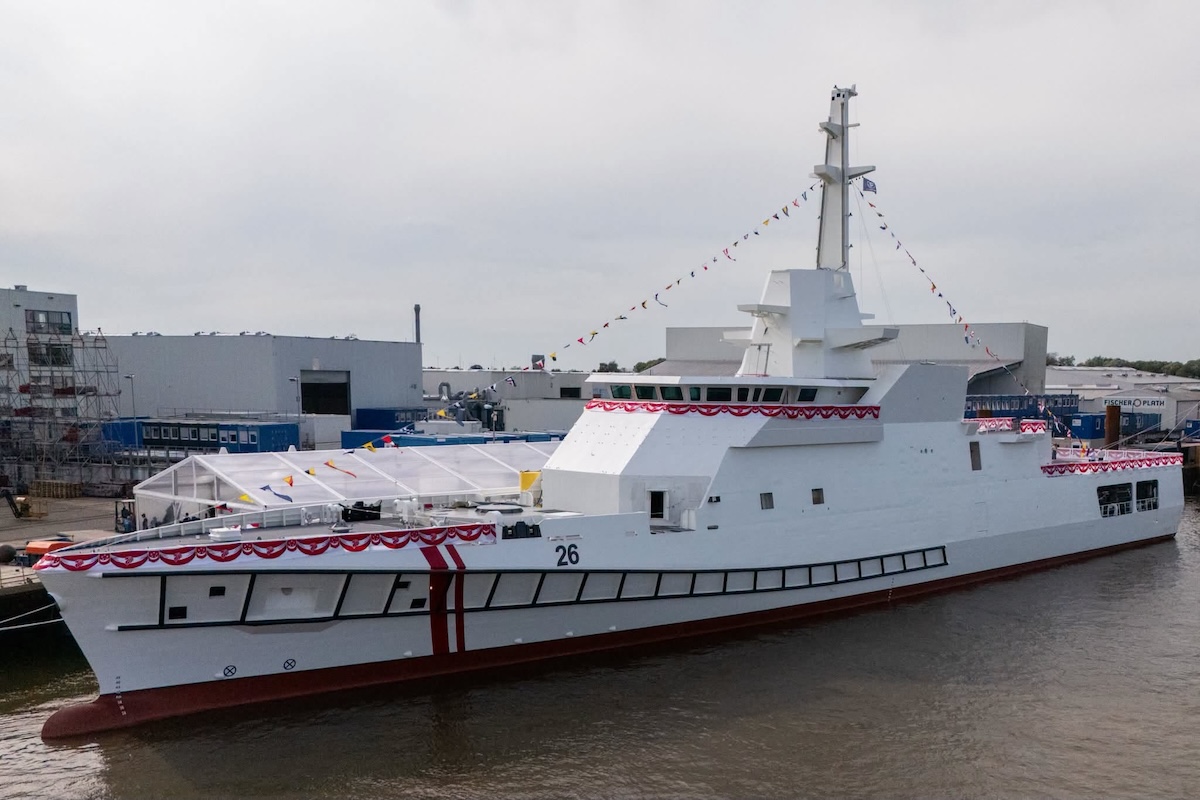

SINGAPORE launched its first Sentinel-class offshore patrol vessel for the Republic of Singapore Navy (RSN) at the Fassmer shipyard in Germany. The vessel was launched in a ceremony officiated by the nation’s defence minister Chan Chun Sing together with Germany’s Federal Minister of Defence Boris Pistorius, German Navy chief Vice Admiral Wilhelm Tobias Abry, the RSN’s Chief of Navy Rear Admiral Sean Wat and other senior officials.
The launch of Sentinel is testament to the strong and substantive defence ties between Singapore and Germany, further strengthened by the enhanced Defence Cooperation Agreement (eDCA) in 2018. It underpins bilateral defence cooperation in areas of mutual interest, such as in submarine training, defence technology, and cyber defence.
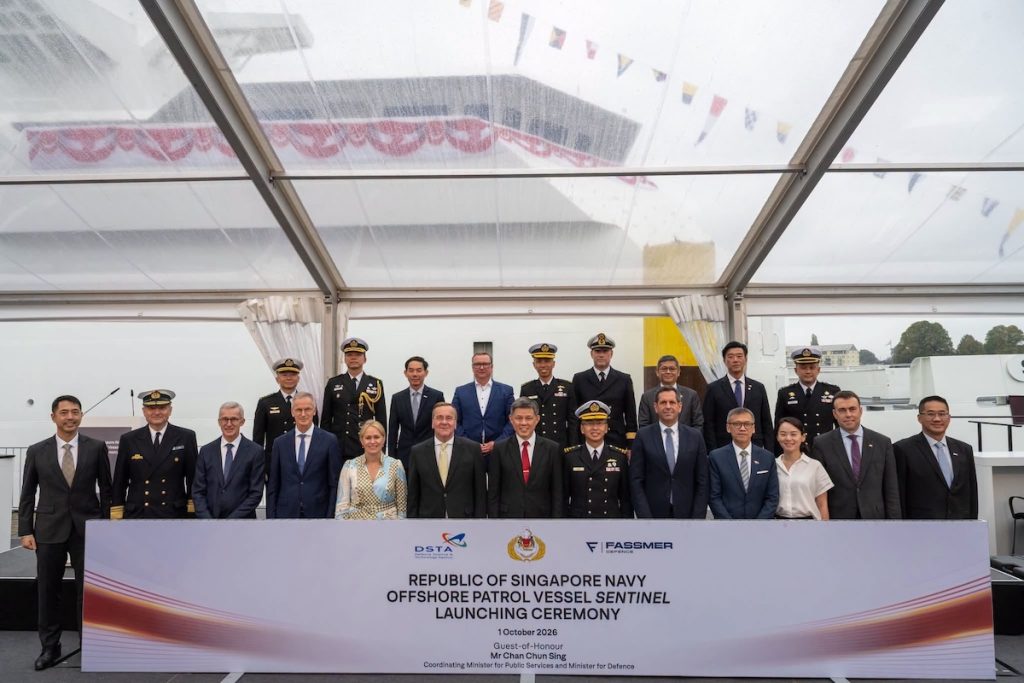
Speaking at the ceremony, Chan highlighted that, “this project is not just a buyer-seller relationship. We are not here just to buy the ship, a boat, from the German industry. This project is also a symbol of the kind of deep relationship that we have between the two navies and between our two countries.” He added that “a ship is built in a couple of years, but the ship will stay with us for a couple of decades, and throughout the couple of decades, it is that constant interaction between the people and the navies that makes this special,” illustrating the longevity of exchanges between Singapore and Germany. He also emphasised, “We see Germany as a trusted partner in these turbulent times… the more turbulent the world is, the more we need trusted partners whom we can rely upon to deliver in good times and tough times.”
In addition, Chan emphasised that the OPV represented the Singapore Armed Forces’ (SAF) constant striving to be ready for threats of the future. Referring to the OPV he said: “It is an example of that commitment to build a ship that is best in its class for today’s needs, but always with the potential to add new capabilities that will allow us to plug and play, and to meet new and emerging threats.”
Following its launch, the Sentinel will undergo a series of platform acceptance and sea trials to validate the ship’s systems and performance prior to departure for Singapore while the remaining three OPVs–Guardian, Protector and Bastion are under construction. It is the first of four OPVs purpose-built to meet the increased demands and wider scope of maritime security operations and will be delivered progressively from 2028.
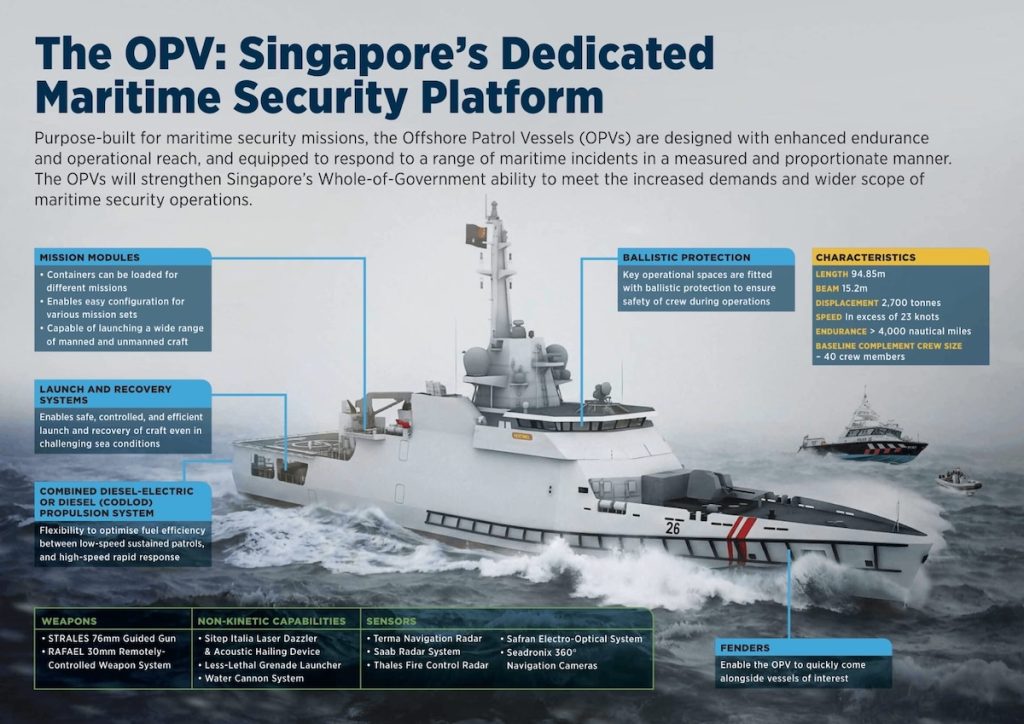


The Sentinel-Class OPVs bear a white hull with red racing stripes, in line with vessels operated by maritime security agencies around the world. reflecting their specialised, maritime security-focused mission set. Once in service, they will interoperate with other government agencies such as the Police Coast Guard (PCG) and the Maritime and Port Authority of Singapore. It is noted that the OPVs will fly the state marine ensign which is used for government-owned or operated vessels on government non-commercial service.
Taking over from the previous Sentinel-class Maritime Security and Response Vessels (MSRVs), the vessels are equipped with calibrated capabilities which enable them to respond to a range of maritime incidents in a measured and proportionate manner. They are also designed for greater endurance with high manoeuvrability to operate effectively in Singapore’s congested maritime environment while being manpower-efficient and modular.
With a baseline crew of 40, the 94.85m long OPVs displacing 2,700 tonnes are armed with a Leonardo STRALES 76mm guided gun and RAFAEL 30mm remotely-controlled weapon system (RCWS) in addition other non-kinetic capabilities such as the Sitep Italia laser dazzler and acoustic hailing device, less-lethal grenade launcher and water cannon. Its sensors onboard include Terma’s navigation radar, Saab’s radar system, Thales’ fire control radar, Safran’s electro-optical system and Seadronix’s 360° navigation cameras.
The bows of the OPVs are fitted with robust fendering to facilitate safe and rapid close-approach and alongside operations with vessels of interest, providing protection to both vessels during contact and manoeuvring. On top of that, key operational spaces are equipped with ballistic protection.
Onboard will be containerised systems that can be configured accordingly in addition to being able to launch various manned and unmanned craft from the stern. Its Launch and Recover System (LARS) facilitates the safe, controlled and efficient launch and recovery of craft from the stern. It reduces handling time and crew exposure, while providing reliable operation in challenging sea conditions and improving overall vessel operational efficiency.
Powered with Combined Diesel-eLectric Or Diesel (CODLOD) propulsion system, it provides the flexibility to balance fuel efficiency and speed according to operational needs, being able to operate efficiently at lower speeds for long-duration patrols while providing high-speed capability when rapid response is required.–-shp/adj/dl (Pix:RSN,MINDEF)