
Duncan Looi
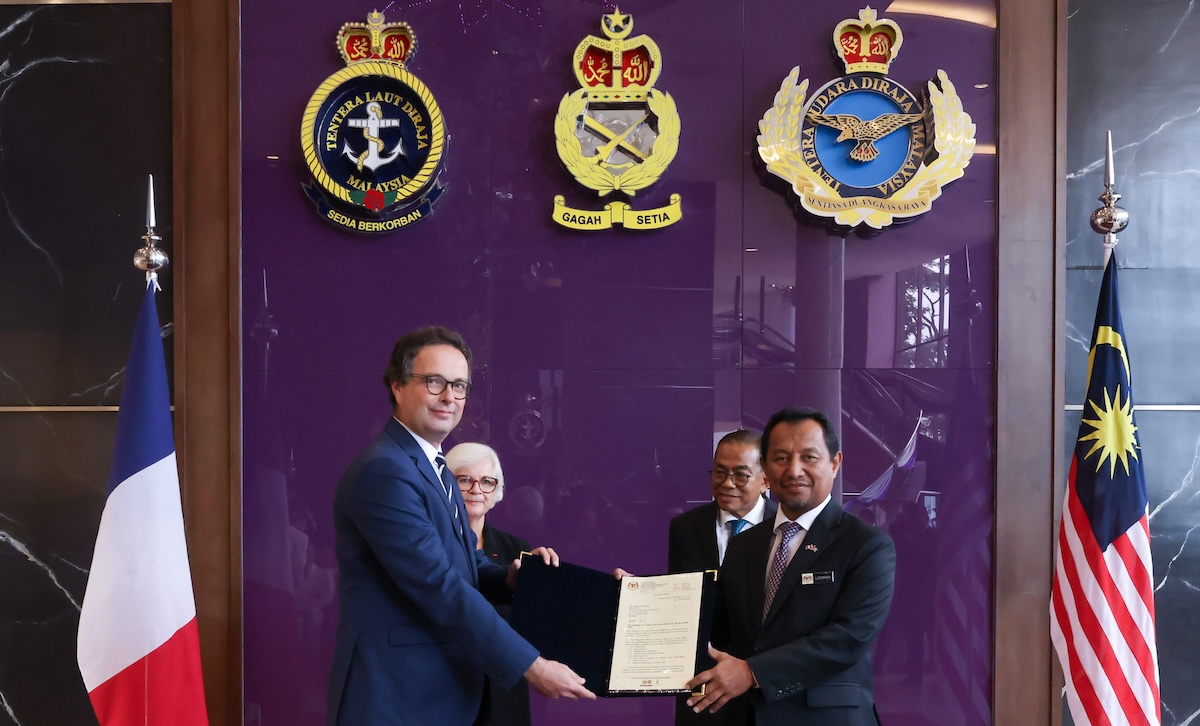
MALAYSIA and France have reinforced their defence ties with the handover of seven letters of intent for the Malaysian Armed Forces (MAF) to French companies the sidelines of French president Emmanuel Macron’s visit to Malaysia, seeking stronger ties in defence, trade, energy transition and critical minerals ahead of 70 years of bilateral ties next year.
Headlining the meeting was the proposed phase one acquisition of four combat search and rescue helicopters (CSAR) helicopters from Airbus Helicopters, with the signing witnessed by President Macron and Prime Minister Anwar Ibrahim. The helicopters would likely be Airbus’ popular H225M variant that is already in service with the Royal Malaysian Air Force (RMAF), though reports did not yet specify the model and specifications. “The proposed procurement was part of the RMAF Capability Development Plan 2055 (CAP55), aimed at strengthening air operational capabilities, including special operations, humanitarian assistance and disaster management,” said Malaysian defence minister Khaled Nordin.
Airbus Helicopters has long proposed its H225M for the RMAF’s CSAR helicopter requirements, previously stating its willingness to offer the H225M with air-to-air refueling (AAR) capability, a requirement outlined in Malaysia’s proposed acquisition for CSAR helicopters and a capability that could even be reconfigured onboard the RMAF’s existing dozen H225Ms, though it would be complicated. The H225Ms could then also be refuelled from the Airbus A400M, another platform operated by the RMAF to give the far-reaching H225M even more range, a strong advantage in CSAR missions. Malaysia was the first operator of the H225M in Southeast Asia, which was subsequently followed by the air forces of Thailand, Indonesia and Singapore. Malaysia was also notably the first export customer of the A400M, with Indonesia being the latest in the region.
Airbus Helicopters senior vice-president/head of APAC Vincent Dubrule previously said: “That is why for example in Malaysia, AAR was one of the specifications for their subsequent batch of helicopters. Their existing fleet of 12 H225Ms could be reconfigured but it would be complex, but it is clear that AAR is an important capability that they hope to, and need to possess.” “To the best of my knowledge, no other manufacturer is able to offer that. We are ready to export that technology with the support of the French authorities to explore the H225M with AAR capabilities for our existing customers and future customers,” said the company’s executive vice-president of global business Olivier Michalon added.
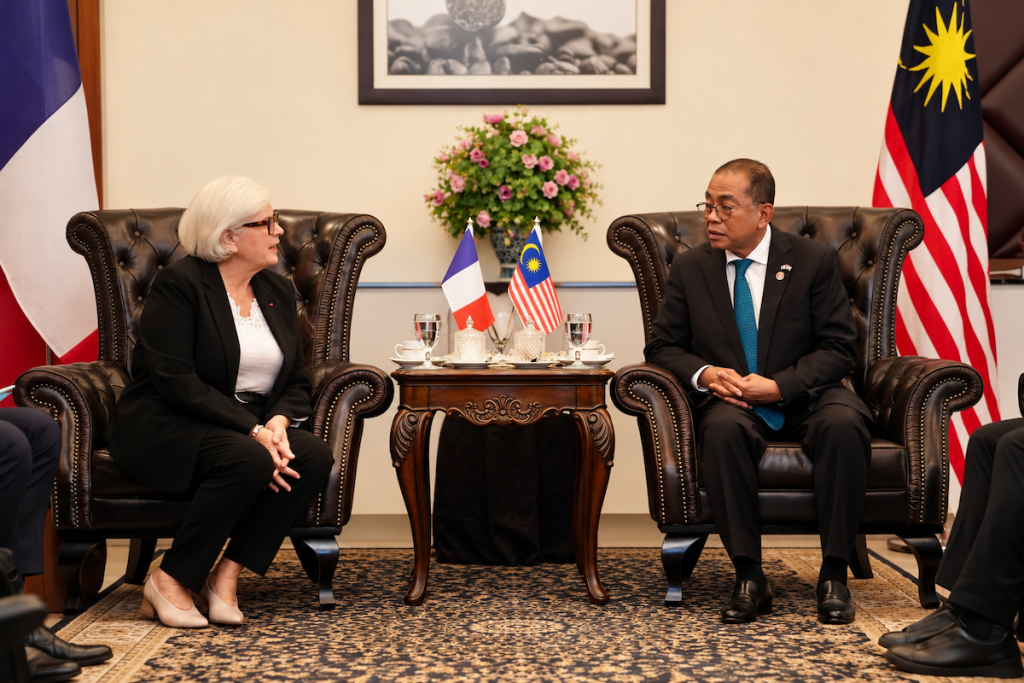
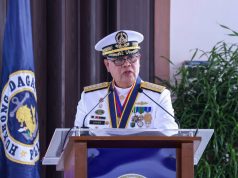
Later at the defence ministry, France’s Minister for the Armed Forces and Veterans Affairs Catherine Vautrin held a bilateral meeting with minister Khaled together with defence ministry Secretary-General Lokman Hakim Ali and Royal Malaysian Navy (RMN) chief Admiral Zulhelmy Ithnain representing Chief of Defence Force (CDF) General Malek Razak Sulaiman for the signing of LOIs and exchange of three memoranda of understanding (MOU).
Franco-German firm KNDS was given an LOI for the proposed purchase of 105mm light artillery howitzers for the Malaysian Army, including 36 gun components for local integration, along with supporting equipment likely by the company’s local agent Advanced Defence Systems (ADS). The procurement will likely an additional batch of KNDS’ 105LG howitzer which has also been in service with the Malaysian Army for several years.
The company entered a strategic partnership with its Malaysian partners for local assembly of the howitzer, becoming a major benchmark. As the world’s lightest 105mm gun, the 105 LG is suited for helicopter-borne and airborne operations and demonstrates KNDS’s expertise in artillery.
Earlier in June, the company had also announced that Malaysia would procure 18 units of their 155mm CAESAR self-propelled howitzers, becoming the platform’s 15th customer and third in Asia after Thailand along with Indonesia. KNDS and ADS formalised the order for 18 units of the CAESAR, a deal which includes the grant of a licence for technology transfer and assembly of the platforms in Malaysia.


After that, local firm Boustead Submarine Engineering Services handed over three LOIs to Naval Group, Thales and Safran respectively for the mid-life upgrade (MLU) of two Prime Minister-class Scorpene submarines operated by the RMN, KD Tunku Abdul Rahman and KD Tun Abdul Razak. The MLU would encompass the submarines’ combat management and integrated platform management systems, depth trim network maintenance and spare parts.
“Thales will modernise the submarines’ radar electronic support measures (RESM) and sonar systems, while Safran will upgrade their search optronic mast and attack periscope systems, with local firm Hexide Engineering Services serving as its local service partner and recipient of technology transfers,” Khaled said.
In addition, several Malaysian companies exchanged MOUs on further defence industry cooperation, including Weststar Aeropace’s pair of MOUs with Thales covering potential cooperation in satellite technology, missile and rocket technology, and cybersecurity, including satellite communications, missile guidance and targeting, and tactical cyber defence.
Malaysian military vehicle manufacturer MILDEF also exchanged an MOU with Thales to equip the 136 locally made Tarantula armoured vehicles being supplied to the Malaysian Army with tactical communications and battlefield management systems while aerospace MRO firm Global Turbine Asia (GTA) agreed to partner on helicopter engine component repairs and training. GTA is responsible for MRO operations for the TP400-D6 engines powering the RMAF’s A400M fleet as well as the Makila 2A1 engines powering the H225Ms.
Malaysia’s strengthening of defence ties with France further bolsters France’s defence partnership with the country and Southeast Asia in general, particularly Indonesia, Thailand, Singapore, Brunei and Vietnam. France has supplied many of the MAF’s big-ticket assets including the aforementioned Scorpene submarines, self-propelled CAESAR and 105 LG1 towed howitzers, H225M helicopters, A400M airlifters, even radios over the years. Additionally, Naval Group’s Gowind-class design was selected for the RMN’s future Maharaja Lela-class Littoral Combat Ship (LCS) programme which sees the 5-ship programme being executed by local shipyard Lumut Naval Shipyard (LUNAS).
Ultimately, the cooperation would strengthen armed forces readiness and operational capabilities while supporting the National Defence Industry Policy (NDIP), serving as a catalyst for developing a downstream defence ecosystem through technology transfer, expertise development and greater participation by local companies in the defence industry. Khaled further said that cooperation with French original equipment manufacturers (OEM) could also create opportunities for Malaysian companies to participate in the global defence supply chain, expand business opportunities and enhance the competitiveness of the local industry.
“The ultimate goal is to develop Malaysia’s sovereign capabilities, enabling the country to independently develop, integrate, maintain and support its defence systems, while reducing dependence on external parties. The Defence Ministry hopes that this cooperation will translate into tangible outcomes and deliver long-term benefits to MAF readiness, defence industry development, as well as national security and sovereignty,” a ministry statement read.
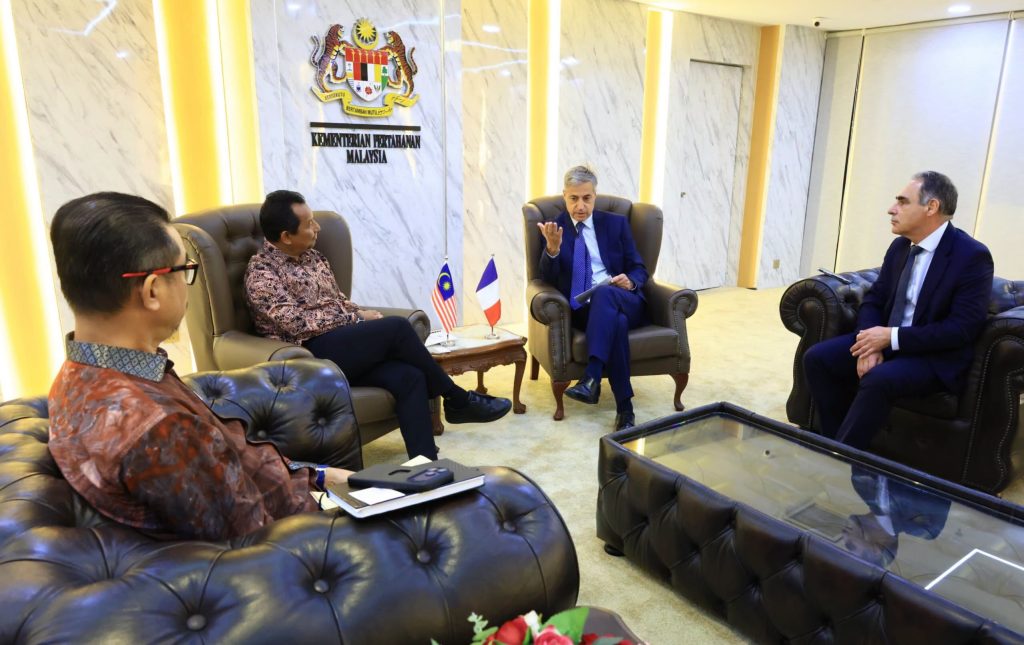
Last week, France’s ambassador to Malaysia Marc Abensour together with a delegation from Dassault Aviation called on the Secretary-General Lokman, discussing the prospects of Dassault’s increasingly popular Rafale fighter jet for the RMAF’s long-delayed multi-role combat aircraft (MRCA) programme.
Aside from that, the three strategic defence cooperation documents were discussed, covering defence capability development, regional security, and protection of classified information. The first document was the Roadmap on Bilateral Defence Capabilities and Defence Industrial Partnerships which outlined the course of long-term cooperation, followed by the second which is the creation and development of a Regional Centre to Combat Hybrid Threats (RC-SHIELD) to address hybrid threats such as cyberattacks, information manipulation and foreign interference with ASEAN nations potentially able to join later on. The third is the Amendment to the 1997 Security Agreement on the Exchange and Protection of Classified Information to strengthen protection and security of classified information exchange between the two countries.–-shp/adj/dl (Pix:MINDEF)