

ADJ
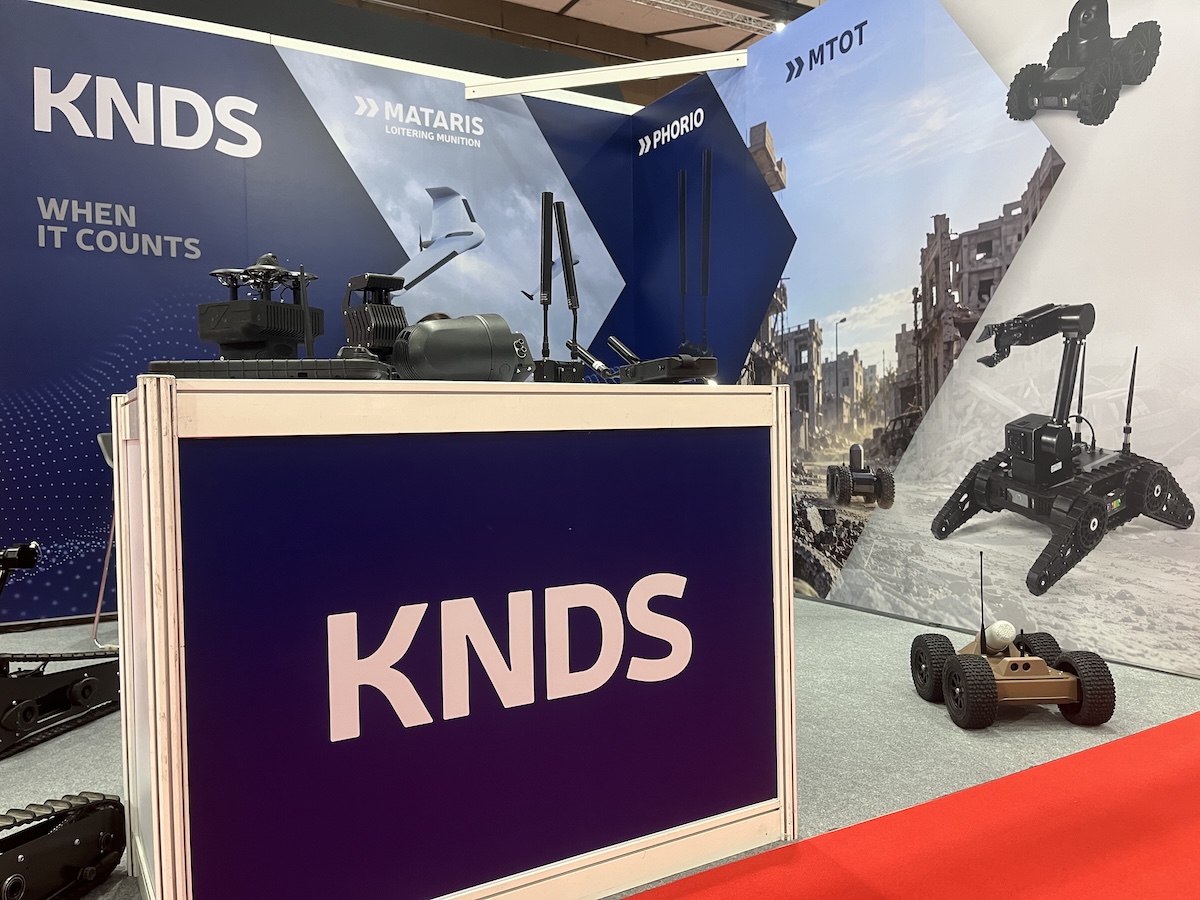
KNDS showcased its expertise in robotics and unmanned technology as well as its expertise in the ordnance segment. Among the innovative solutions on display was the company’s new MTO-T loitering munition making its debut in the region.
The company featured its MATARIS loitering munition, comprising a family of unmanned aerial vehicles (UAV) equipped with the company’s explosive charge for anti-personnel or anti-armour purposes. The MATARIS line comprises the MT-10 short-range loitering munition with a 550g fragmentation payload. Next the MX-10 DAMOCLES quadcopter which carries KNDS’ fragmentation-incendiary warhead payload similar to the MT-10 for the same targets at ranges of up to 10km.
Following that, the MV-25 OSKAR which was the French loitering munition, it can fly and loiter as far as 25km and also carries a 550g payload. These three systems are all designed to defeat infantry squads and light vehicles. Finally, the MV-100 VELOCE which is a medium-range loitering munition intended to target armoured vehicles on the battlefield as far as 100km away. The MV-100 carries a very high velocity and explosively formed penetrator charge to deliver accurate hits on armoured vehicles. The entire range was developed in record time to urgently fill a capability gap in the French military arsenal, in close cooperation with drone specialists DELAIR and EOS TECHNOLOGIE.
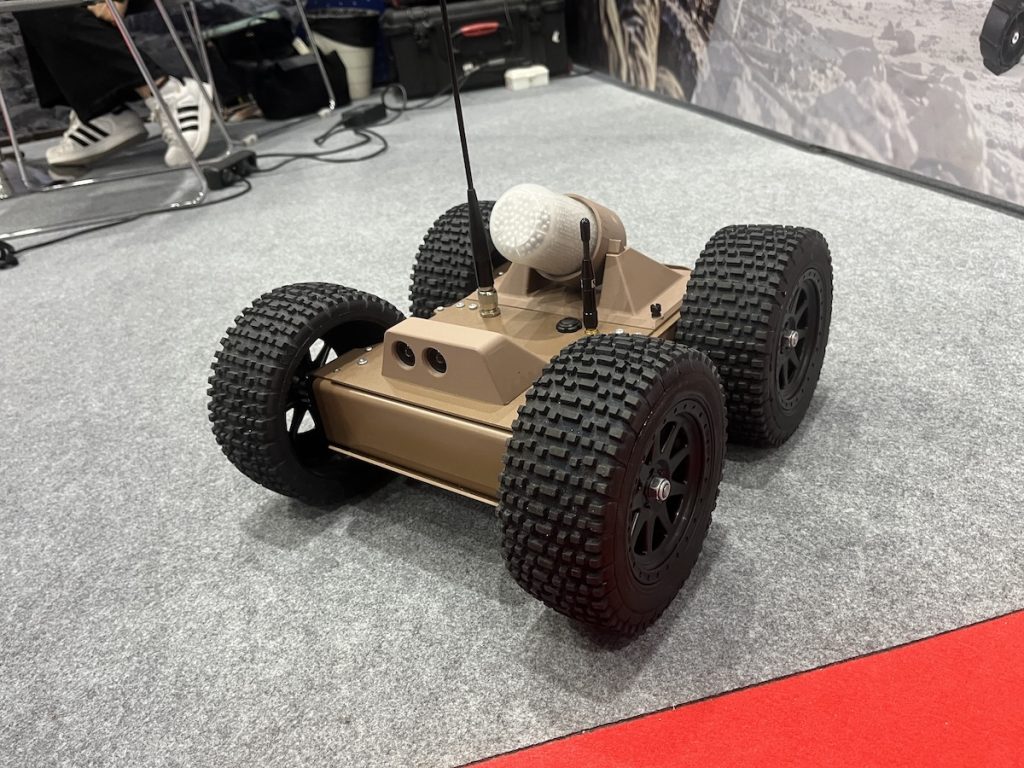
Also present was the new MTO-T ground loitering munition developed in direct response to lessons from the conflict in Ukraine. Engineered for large-scale production at a controlled unit cost, the MTO-T fills the gap left by low-cost ground robots and complements aerial UAVs precisely where they are least effective: dense urban environments, underground spaces, and areas subject to satellite navigation jamming or anti-drone saturation. It adds on the company’s popular NERVA LG and XX multi-mission tactical robots. The NERVA LG system is best-suited for reconnaissance, observation and detection while the NERVA XX is best for counter-improvised explosive device (IED), observation and detection and more. Different payloads can be integrated with the NERVA line, including cameras, drones, 2D mapping and more.
KNDS’ booth also featured its latest PHORIO radio which can be paired with its range of unmanned ground solutions such as the NERVA. It was launched earlier this year at Defence Services Asia and National Security Asia 2026 (DSA & NATSEC). Developed for ground-based and aerial robotic systems, PHORIO offers the versatility to simultaneously transmit critical data: command and control, video streams, voice, and data. This solution ensures uninterrupted communications in all environments, particularly disruptive and hostile environments.
Its advanced frequency-hopping and transmission security capabilities ensures uninterrupted communications in the face of modern electromagnetic threats, often to enable the use of teleoperated weapons. Its Software-Defined Radio (SDR) architecture also makes it fundamentally scalable and can be enhanced through simple software updates, without any hardware.modifications. That allows new features to be added, optimises radio performance, improves anti-jamming algorithms and even integrates new communication modes as well as customer-specific protocols. PHORIO offers technological longevity, reduces obsolescence cycles, and enables armed forces to benefit from incremental capability improvements throughout the system’s lifecycle.
KNDS ultimately hopes to work closely with the Thai industry and other prospective countries to integrate its line of ordnance into more unmanned technology.–-shp/adj/dl (Pix:ADJ)