Duncan Looi
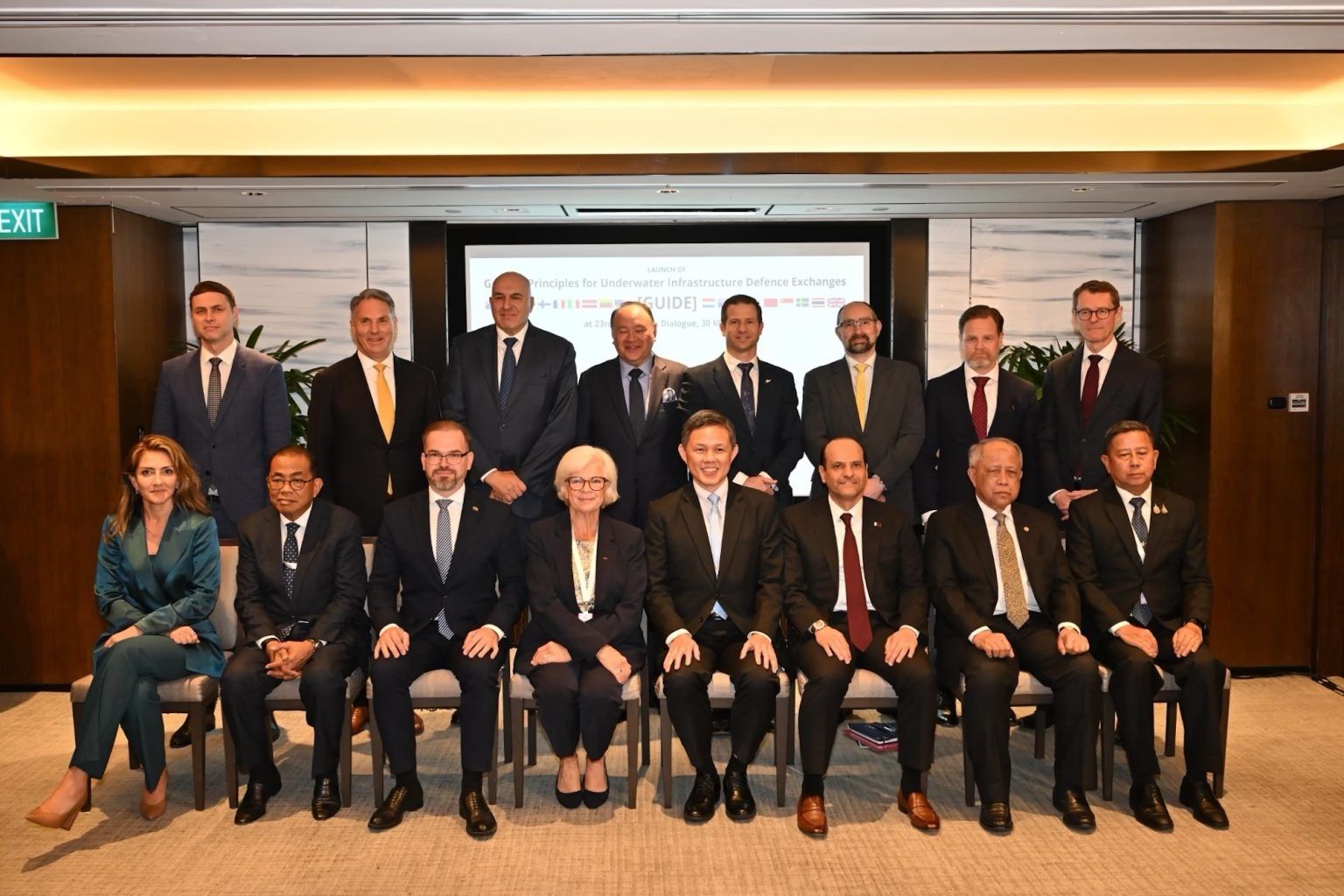
LAUNCHED at the 23rd International Institute for Strategic Studies (IISS) Shangri-La Dialogue in Singapore, the “Guiding Principles for Underwater Infrastructure Defence Exchanges” (GUIDE) was endorsed by 17 countries with common interests in the security of critical underwater infrastructure (CUI) and is an agreement of shared principles and potential areas where defence establishments could collaborate on to enhance CUI security.
GUIDE was endorsed by Australia, Brunei, Estonia, Finland, France, Italy, Latvia, Lithuania, Malaysia, the Netherlands, New Zealand, the Philippines, Qatar, Singapore, Sweden, Thailand, and the United Kingdom.
A Singapore defence ministry statement stated, “The cross-regional nature of GUIDE reflects countries’ desire to work together on shared security challenges that transcend geographical regions. GUIDE is an example of how geography is not a barrier, and that countries can collaborate in flexible, issue-based groupings to shape the rules and norms in emerging domains.”
“Today, the waterways are not just avenues for us to conduct our trade, but underneath those waters are also critical underwater infrastructure that connects our energy grid and our telecommunications grid,” said Singapore’s defence minister Chan Chun Sing.
Any disruption on one part of the network is a disruption on the entire network. That is why it gives us great joy to see so many countries – from Europe to Middle East to Southeast Asia, Asia-Pacific – coming together. We may not have all the answers, but we certainly want to work on these issues together to see how we can establish those international norms to build those infrastructures, maintain those infrastructures, and to protect those infrastructures, deterring those may mean harm to our infrastructure and our way of life,” he added.
According to the ministry, global communications networks are dependent on subsea telecommunications cables, which carry more than 95% of all internet and data traffic under the ocean. On the energy front, States also rely on subsea energy transmission infrastructure, such as oil and gas pipelines and power cables. Collectively, these CUI systems and related elements are essential to our connectivity, economic growth, and way of life.
However, recent incidents involving cuts or damage to subsea telecommunications or energy cables and pipelines have underscored the vulnerabilities of CUI. Such incidents also show the difficulties in responding outside of territorial waters, including challenges in attribution, jurisdiction and enforcement. We hence welcome the increasing attention placed by governments, private industry, and international/multilateral organisations to developing secure, reliable and resilient CUI, as well as improving multinational and multi-stakeholder cooperation in responding to CUI incidents. While these broader efforts are civilian and industry-led, we see a role for defence establishments and militaries to support and complement the efforts of our national civilian agencies and the private sector in enhancing the security of CUI, such as contributing ships, aircraft, and unmanned underwater vessels to support maritime surveillance.
The GUIDE expresses our collective commitment to continue working together on cross-border security challenges that transcend geographical regions, and to strengthen multilateral frameworks, rules and norms, and mechanisms for cooperation. Specific to the security of CUI, we seek to build on national initiatives, regional efforts such as those within Europe, Southeast Asia and Oceania, as well as broader multilateral and international frameworks. It aims to articulate common guiding principles and best practices, and highlight potential areas for cooperation by defence establishments to support civilian agencies in enhancing CUI security, that can be applied across our regions.
This GUIDE is voluntary, and non-legally and non-financially binding. It does not create new legal obligations nor prejudice existing rights and obligations under international law, including the 1982 United Nations Convention on the Law of the Sea (UNCLOS), and is implemented in accordance with national laws and policies as well as international law.
GUIDING PRINCIPLES
Defence establishments endorsing this GUIDE aspire to the following guiding principles to support CUI security:
- CUI and Related Elements are Critical Infrastructure. Acknowledge the importance of CUI, which includes submarine telecommunications and energy cables, and oil and gas pipelines, as critical infrastructure, and therefore the importance of CUI security. Moreover, a practical view of CUI security should also consider connected elements and other supporting infrastructure necessary for the overall functioning of CUI.
- Respect for Sovereignty and Jurisdiction, and Rights and Freedoms, in Accordance with International Law. Respect the sovereignty, sovereign rights, and jurisdiction of coastal States as well as the rights and freedoms of other States, including the freedom of navigation and overflight, the laying and maintenance of submarine cables and pipelines, and other internationally lawful uses of the sea related to these freedoms, in accordance with international law, including the 1982 United Nations Convention on the Law of the Sea (UNCLOS).
- Multi-stakeholder Coordination and Cooperation. Underscore the importance of coordination and cooperation among multiple stakeholders in CUI security, who all have a role to play. They include governments and relevant national authorities of coastal States and cable-user States; private industry such as submarine cable and pipeline operators, marine stakeholders in the shipping industry; as well as international and non-governmental organisations like the United Nations, International Maritime Organisation, and the International Cable Protection Committee. We also welcome the potential contributions of academia and experts, who can support discussions.
- Civilian Led, Defence Support. Acknowledge that defence establishments play complementary and supporting roles in addressing threats to CUI security, where appropriate and subject to the specific national structures and division of responsibilities within each country, with civilian authorities and private operators bearing primary responsibility for the design, regulation, building and repair of secure, reliable and resilient CUI.
- Voluntary Practical Defence Cooperation. On a voluntary and non-binding basis, encourage practical cooperation activities amongst defence establishments, which could include the areas listed in the section below. At the same time, given our multi-stakeholder approach, we also encourage broader cross-domain sharing and engagement with civilian agencies and private industry, to promote CUI security.
POTENTIAL AREAS OF COOPERATION
Defence establishments endorsing this GUIDE also express our interest in exploring the following potential areas of cooperation to support CUI security, subject to our own national requirements and resource commitments.
Specific follow-on initiatives may be undertaken by interested States on a purely voluntary basis. Initiatives conducted under the ambit of this GUIDE should also be open to all GUIDE-endorsing defence establishments to consider participating on a voluntary basis. The decision to host or participate in follow-on initiatives, and their exact scope, can be discussed separately by the interested States, which will be subject to their respective national approval processes.
- Dialogue and Exchange of Best Practices: Promoting discussions and exchanges, especially across regions and between sectors, to: (i) deepen understanding of each participant’s national approaches for CUI security; (ii) share best practices, measures, and lessons learnt, including from our own national and regional experiences; and (iii) identify common themes and build wider understanding of how defence establishments can contribute towards CUI security in support of civilian agencies. Where opportune, we should encourage cross-sectoral sharing and engagement, with civilian agencies, private industry and marine stakeholders.
- Awareness of International Law and Norms: Raising awareness of, and supporting civilian agencies where appropriate, in promoting the application of relevant international law principles concerning CUI, in relation to security of CUI.
- Information-Sharing: Enhancing inter-regional information-sharing to support maritime awareness and early warning for CUI security incidents, working closely with civilian maritime agencies, defence partners, private operators, and the commercial shipping community.
- Technical Exchanges: Sharing best practices and technical knowledge through organising subject-matter expert exchanges on CUI security amongst States and with civilian agencies – e.g., through workshops – as well as incorporating elements on CUI security into multilateral activities.
- Incident and Crisis Response: Exchanging points-of-contact and sharing on our national agencies and coordinating structures for CUI security to facilitate intra-regional engagements and enhance our potential incident and crisis response for CUI-security related issues, should the need arise.
- Awareness of GUIDE:Promoting awareness of the GUIDE’s guiding principles and potential areas of cooperation with other defence establishments, as well as relevant stakeholders, including civilian authorities, regional and international organisations, industry and academia.