
Duncan Looi
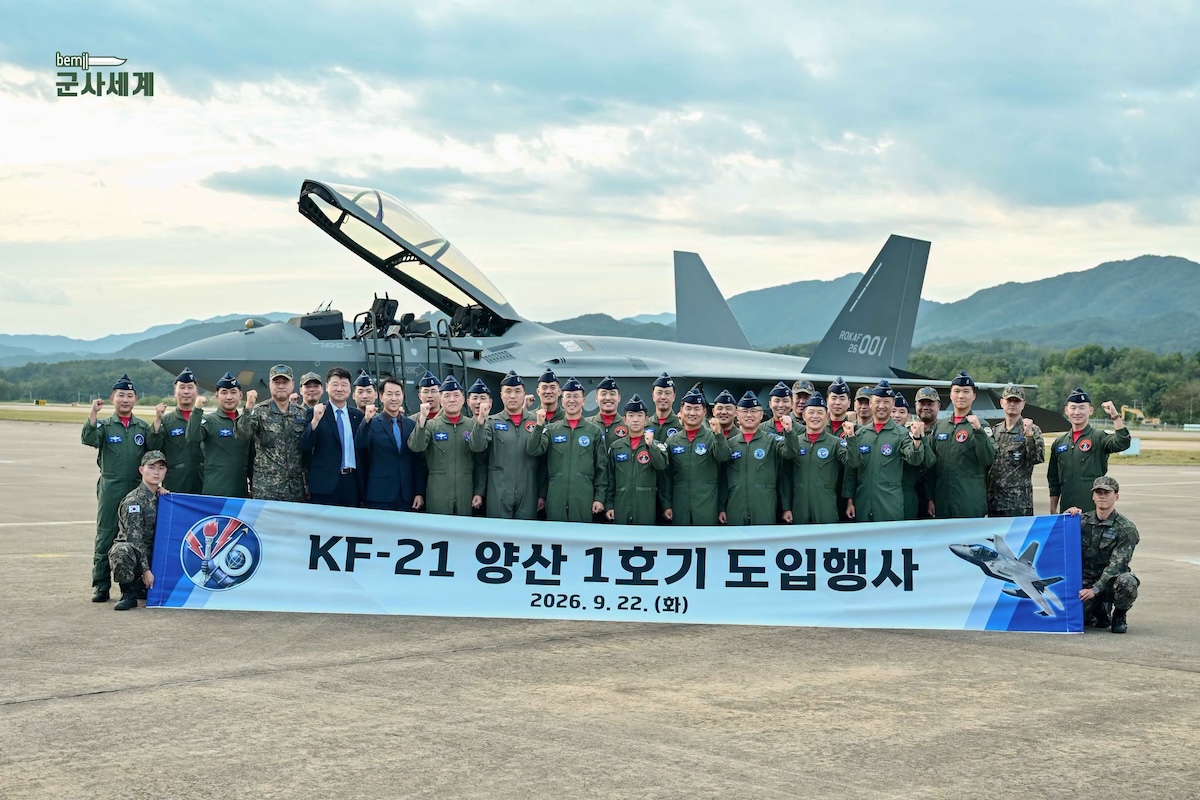
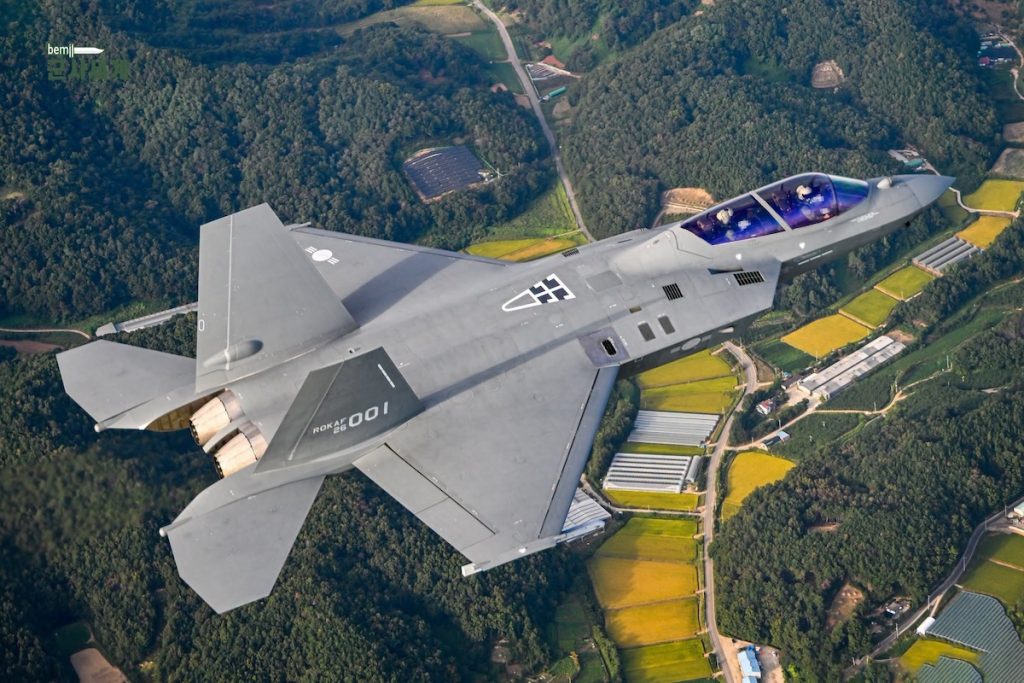
SOUTH Korea’s homegrown KF-21 Boramae “Young Hawk” from Korea Aerospace Industries (KAI) completed its maiden flight for the Republic of Korea Air force (ROKAF) as part of an official ceremony marking its delivery to the service.
The twin-seater aircraft is the first mass-produced KF-21 and flew from KAI’s Sacheon manufacturing plant south of Seoul to Yecheon Air Base escorted by an FA-50 light fighter, a TA-50 fighter-trainer and T-50 Golden Eagle trainer, all products of KAI. Welcoming the new jet was the 156th Fighter Squadron, a squadron which was reactivated in June after 14 years since its deactivation.
Coming off the assembly line in March, it marked the culmination of its 25-year indigenous development programme and new era for the South Korean defence industry. Mass production of the KF-21 kicked off in June 2024, with the platform officially receiving a combat suitability certification after over a decade of development and testing in May 2026 and completing systems development the following month.
“Overcoming numerous trials and hardships, the KF-21 was handed over to the Air Force today and commenced flight operations. Up until yesterday was the time for the Boramae project’s policymakers and developers. From today onward, it is the Air Force’s time. I call upon every service member operating the KF-21 to take immense pride and responsibility in managing our nation’s premier fighter jet, uniting to ensure the KF-21 rapidly establishes itself as the ultimate shield defending the ROK,” ROKAF Chief of Staff General Son Sug-rag said.
According to the ROKAF, the service plans to field more than 100 KF-21s in phases by early 2030 as KAI looks to manufacture 40 KF-21s focused on air-to-air capabilities for delivery by 2028 before producing 80 more equipped with long-range air-to-ground missiles (AGM) by 2032.
Simultaneously, another South Korean defence giant–Hanwha Aerospace announced its partnership with KAI on a domestically developed long-range air-to-air missile (AAM) to be integrated on the KF-21. The two companies initially partnered on overseas marketing of South Korean aircraft and to share supplier networks but signed another agreement which encompassed aircraft weapons integration and joint export marketing. Hanwha Aerospace supplies the engines, landing gear and flight-control equipment while Hanwha Systems provides the active electronically scanned array (AESA) radar, electro-optical targeting pod, infrared search-and-track system and mission computer


Last December, BAE Systems received a US$11 million contract from KAI to integrate the AN/APX-127(V)1 Combined Interrogator Transponder (CIT) on the KF-21. The latest Identification Friend or Foe (IFF) system enables enhanced decision-making capabilities to distinguish between allied forces and potential threats in contested scenarios.
With the same form factor, the AN/APX-127(V)1 is a drop-in replacement for the AN/APX-126(V) CIT currently fielded on the KF-21. It is Mark XIIB IFF certified with Mode S and Mode 5 for secure and encrypted data exchange. The upgraded system enhances situational awareness for warfighters with additional receive channels for passive acquisition of Mode 5 Level 2 and Automatic Dependent Surveillance – Broadcast In to detect and identify friendly aircraft in complex and dynamic environments.
In addition, KAI has also partnered with missile giants MBDA and Diehl Defence to increase the KF-21’s lethality. In October 2025, KAI and MBDA signed the SPEAR Missile Integration Cooperation memorandum of understanding (MOU) to enhance the KF-21’s Sustainable Air-to-Ground Armament Expansion. The agreement is aimed at expanding the integration of the SPEAR next generation air launched Surface Attack Weapon onto the export‑configuration KF‑21 which already carries MBDA’s METEOR long‑range AAMs, adding the SPEAR missile would considerably enhance its air‑to‑ground lethality. Both KAI and MBDA have expressed a commitment to further expand armament integration and strengthen joint efforts to promote the KF‑21 and its associated weapons package in international markets.
Additionally, KAI and Diehl Defence marked the completion of Diehl’s IRIS-T short range missile integration with the KF-21. In May 2024, the IRIS-T was launched for the first time from the KF-21, The missile was designated by the onboard active electronically scanned array (AESA) radar, and successfully engaged the target drone. The successful live firing demonstrates the technical feasibility and commitment to integrating the missile into KAI’s combat fleet, with the FA-50 integration following closely behind.
The KF-21 has long been speculated to be prime candidates for Southeast Asia’s air power modernisation, among them being the Philippines, Indonesia, and Malaysia. Indonesia, is a partner alongside South Korea in the project, initially agreeing to shoulder 20% of the project cost through June 2026 in return for transfers of technology among other conditions. However, Indonesia had not been able to fulfil its payment commitments and looked to reduce its commitments. Indonesian engineers working on the KF-21 programme were investigated in February 2024 for allegedly stealing technologies related to the jet. Then in June 2025, both countries agreed to reduce Indonesia’s contribution to the programme to just US$400 million, around a third of the original commitment.-–shp/adj/dl (Pix:BEMIL CHOSUN)