Duncan Looi
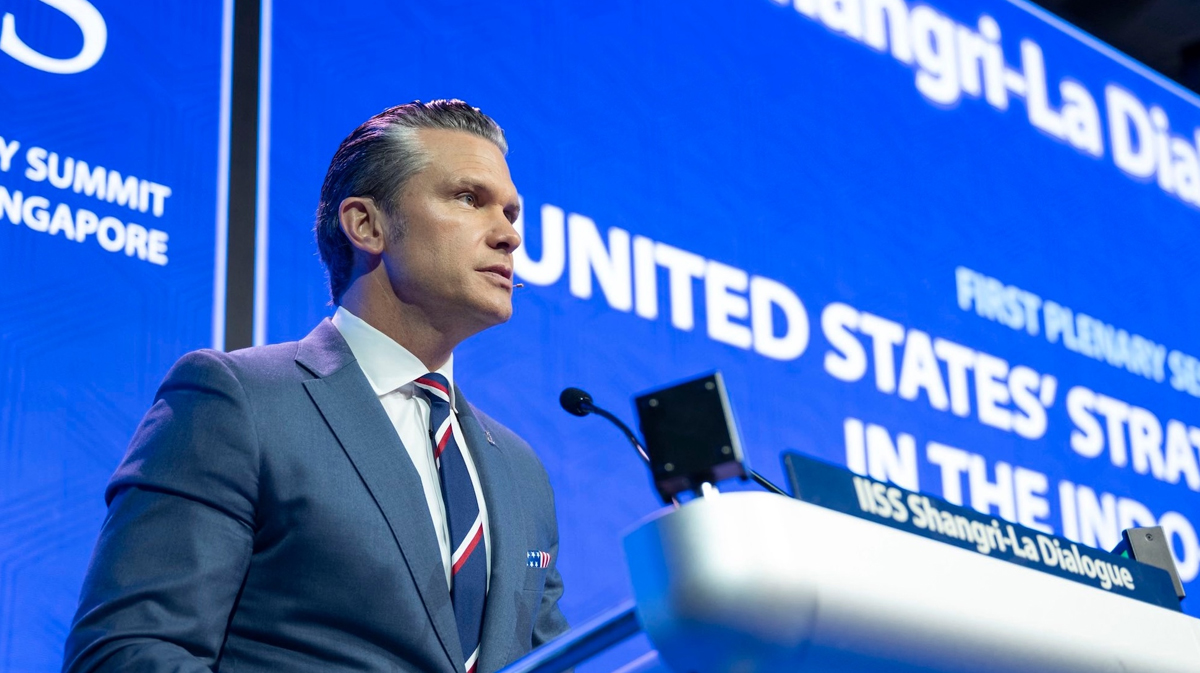
THE United States has called on the Asia-Pacific region to increase defence spending, citing a “rightful alarm regarding China’s historic military buildup and the expansion of its military activities in the region and beyond.” Adding on, he said “We don’t need more conferences. We need more combat power. I’m sorry to say this here: less Shangri-La, more ships, more subs.”
Speaking at the Shangri-La Dialogue organised by the International Institute for Strategic Studies (IISS) in Singapore, US Secretary of War Pete Hegseth delivered his speech to attendees at the premier defence forum in the region. The US expects its allies and partners in the region to ramp up defence spending to 3.5% of respective GDPs while pledging to invest US$1.5 trillion in their own military.
“President Trump is setting the gold standard. We demand 3.5% from our allies and partners, and we are going well beyond that number. We expect every single ally and partner to match that kind of resolve. Our approach asks Pacific nations to do what many are already eager to do: invest seriously in their own defence, contribute more to collective security, and work with the United States in pragmatic ways that advance our shared interests.”
“We are charting a new course for our alliances and partnerships: one that is grounded in the realities of power and interests,” adding on that “The era of the United States subsidising the defence of wealthy nations is over. We need partners, not protectorates. We seek alliances built on shared responsibility, not dependency.”
“This region has profound implications for US security and prosperity. It’s the world’s largest and most dynamic market area. It’s why our national defence strategy directs the Department of War to set the military conditions required to achieve a lasting and favourable balance of power in the Pacific region. When we look across the region today, there is rightful alarm regarding China’s historic military buildup and the expansion of its military activities in the region and beyond. We share a clear-eyed assessment of that security environment and a mutual understanding that a Pacific dominated by any hegemon would unravel the regional balance of power and undermine the equilibrium we all seek to preserve. The Department of War is working with the utmost focus to prevent any such unraveling,” his speech continued.
“What we seek – and what the President has constantly articulated – is a genuinely stable equilibrium that works for Americans and our allies, a favourable but durable balance of power in which no state, including China, can impose its hegemony and hold the security or prosperity of our nation and our allies in question.”
“We will prioritise lethal capabilities, strategic discipline and businesslike cooperation over empty rhetoric and peacocking. Any potential opponent will be forced to judge us by our hard power, collective readiness and our steadfast resolve,” he said, adding that the US military posture in the Pacific region will be resilient, distributed and optimised to deny quick and decisive gains through military force. We will build and sustain a strong denial defence in the Western Pacific that ensures aggression is infeasible, escalation unattractive, and war deemed irrational. Our military posture will be resilient, distributed and optimised to deny quick, decisive gains through military force. This is the logic of strategy and it’s the essence of peace through strength and the foundation of a durable peace in the Pacific that benefits all of us. We all benefit from such a policy, because our quiet but clear strength will lead to stability and peace.”
The Secretary also outlined the need for alliances to work both ways, “This is not a burden America can or should carry alone. A favorable balance of power requires capable allies with real military strength, real industrial capacity, and real political resolve. For too long, the security of this region has rested disproportionately on American military power. While many of our allies and partners allowed their own defence capabilities to atrophy, that’s a bad deal for the American taxpayer and it is an unsustainable crutch for our allies and partners.”
“For those nations that rise to this challenge that embrace responsibility as true partners, the benefits will be clear. As our strategy states, we will prioritise working with model allies those nations who are most capable, clear-eyed and ready to defend their national interests. For those nations, we are moving them to the front of the line, expedited arms sales, deep industrial base collaboration, expanded intelligence sharing, the list goes on that benefits many.”
In his speech, Hegseth praised Australia, India, Indonesia, Japan, Malaysia, the Philippines, South Korea, Singapore, Thailand and Vietnam that “stepped up”.–-shp/adj/dl (Pix:DOW)