

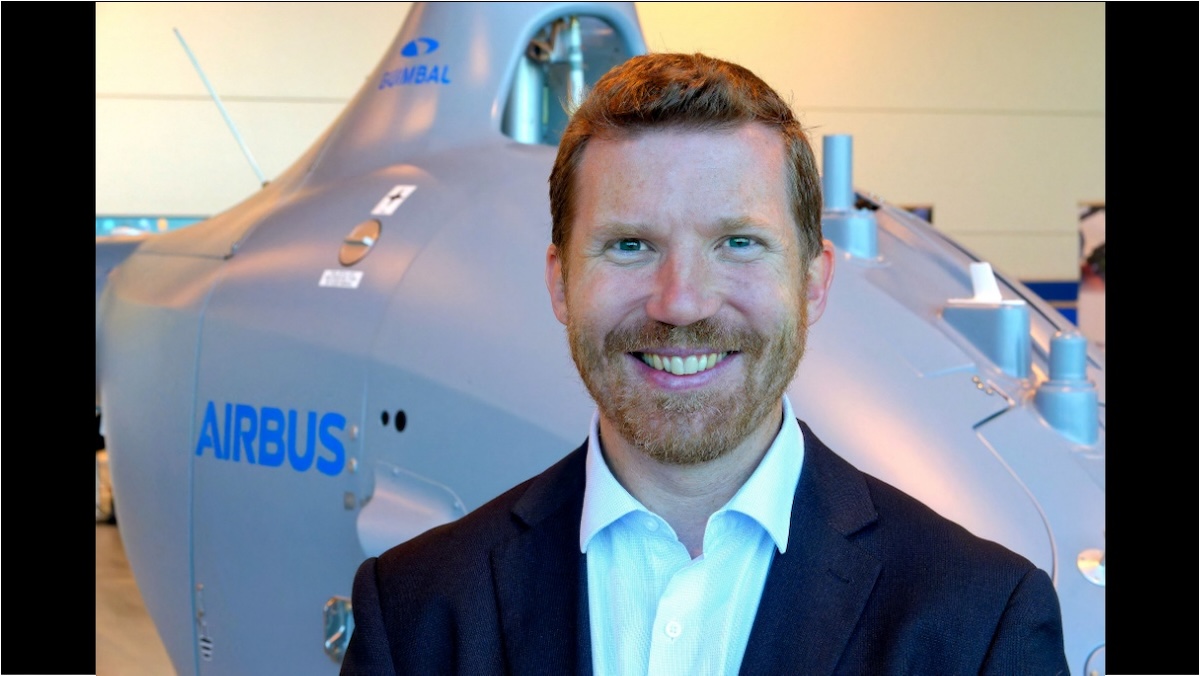
Victor Gerin-Roze, Airbus Helicopters UAS Business Head
ASIAN Defence Journal speaks to Airbus Helicopters’ Uncrewed Aerial System (UAS) business head Victor Gerin-Roze at the recent Singapore Airshow 2026 – updating the industry on its current offerings.
ADJ: With countless firms offering all sizes of unmanned systems for various uses, can you give us an overview of Airbus UAS and how you look to set yourselves apart from others in the industry?
VGR: Here at Airbus, we have extensive experience in rotary-wing and fixed-wing aircraft, not to mention satellites. With this aerospace and aeronautical mindset in our DNA combined with the innovations we have pioneered for decades and vertical flight experience, this is how we separate ourselves apart in the industry. With humility, we know how to put things in flight and we see that as a key differentiator. Our objective is to have our drone able to fly anytime, anywhere for our customers.
To start with our strategy, our unmanned division exists based on three pillars. The first of which are the tactical drones themselves which exist to perform any type of missions, generally encompassing intelligence, surveillance, reconnaissance (ISR), disaster relief, firefighting, armed scout missions and even cargo flights. Though it is not an exclusive list because we continue to create or develop new concepts of operation almost every day with our customers and operators.
There are many missions that our drones can do alone, as they often work best but we see them increasingly more as teammates. Our objective is to team them with crewed helicopters. Which brings us to our second pillar of our strategies, developing technology which allows us to team helicopters and drones in an efficient and seamless way for the operator. This is essential for us to augment the helicopter’s capacity and increase the overall performance of the helicopter in fulfilling missions. Next, our final axis is the development of uncrewed helicopters. It is on this axis that we leverage our heritage by using our existing platforms and converting them into uncrewed platforms.
ADJ: Could you give us an overview of solutions being offered in this domain?
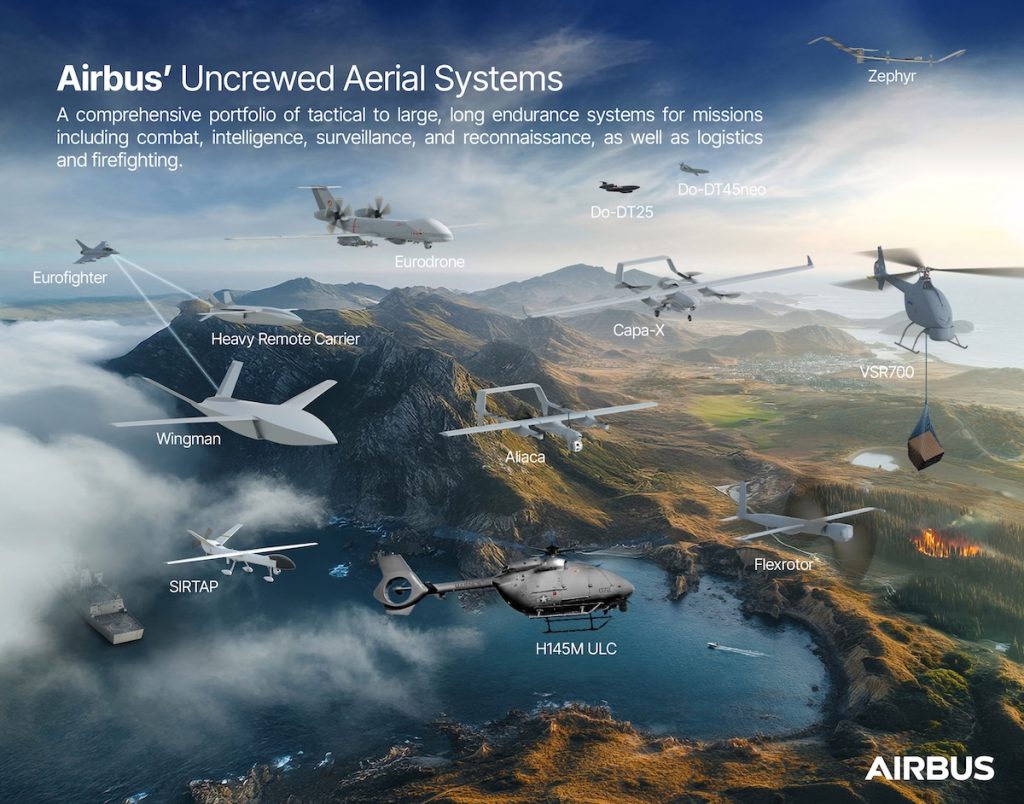
VGR: In terms of presence, we are based at three main sites for our UAS activities. Our first site is in Aix en Provence, north of Marignane, where Airbus’ headquarters is, so we have a dedicated team on UAS that work mainly on the VSR 700, our very own crewed-uncrewed teaming which is called HTeaming as well as the conversion of crewed helicopters into uncrewed helicopters. Next, our facility in Pierralatte is where we work on the Aliaca and Capa-X. It was the site of Survey Copter, another entity of Airbus that focuses on UAS systems which has since been transferred from Airbus Defense and Space to Airbus Helicopters last October to unify our forces on tactical UAS solutions.
Our third site is in Bingen between Washington and Oregon State in the US, where we design and manufacture the Flexrotor which originated from a company we acquired several years ago. The Flexrotor is a highly unique solution because it takes off vertically and takes flight like any other aircraft. So, it is a completely different concept. This serves as our UAS centre of excellence, but our global network is another of our strengths. Airbus Helicopters is present in more than 150 countries which ensures our drones have a strong supply chain and sufficient parts to continue operations. Most of the parts we use in our helicopters are also in our drones, because it is always good to invest in drones, but it is equally or even more important to have a network supporting the operators.
Following that, we can now elaborate more on our lineup of UAS offerings along with our HTeaming solution. From Airbus’ overall view, we have a complete family of products starting from the lightweight Aliaca, up to the Eurodone from Airbus Defence and Space. At Airbus Helicopters, we are driven by our focus on tactical vertical takeoff and landing (VTOL) UAS. We have the Aliaca and the extended range version, the Flexrotor which all lean towards the ISR mission-set and even Intelligence, surveillance, target acquisition, and reconnaissance (ISTAR). These are ideal for expeditionary missions, ISR, and very-long endurance in comparison to group one drones. The key is endurance, especially in the civil theatre for disaster relief or search and rescue (SAR) because the drones need to stay airborne for prolonged periods and not rotate drones every few hours. This applies to military missions as well.
The Capa-X can perform ISR missions while carrying 20kg payloads of either cargo or ordnance. For instance, it can execute short-distance logistics missions on the battlefield at the frontlines or even medical payloads for civil use, which is something we are actively pursuing with operators. Above that, you have the VSR 700, and uncrewed H145 which are able to carry as much as 200kg and two tonnes respectively. The VSR 700 can be said to be the Swiss Army knife of drones, it can perform ISR missions with electrooptical equipment and radars which is in the French military configuration. That is its main mission but it is also well suited for uncrewed cargo missions, along with anti-submarine (ASW) or anti-surface warfare (ASuW) for naval applications, even light armed scout configuration as well.
Beyond that, the uncrewed H145 which is still under development, is a four-tonne class platform that is really a perfect multirole platform in our range of solutions. It is significant because the H145 is among the best light utility platforms currently offered in the market, with thousands already flying since its introduction. So with the uncrewed H145, we are combining the best of both worlds between drones such as the VSR 700 and the H145 helicopter. It is our vision that the H145 is the future backbone of any logistics capabilities both for military or civil applications. With a two-tonne capacity, it can truly perform those tasks seamlessly as the cabin configuration is completely revamped. We are not just “uncrewing” the H145, we are completely transforming the cabin to tailor it for a variety of missions. The Capa-X, VSR 700 and uncrewed H145 can serve as attack drones, surveillance, ISTAR, ASW, ASuW drones and cargo as well as ALE carriers.
ADJ: As unmanned systems become more and more prominent across the battlespace, what are Airbus’ priorities in the unmanned/uncrewed industry?
VGR: In terms of our ambitions, what we aim to achieve is to solve customer challenges with crewed and uncrewed assets. We take on challenges and we attempt to develop solutions for those concepts of operations that give our customers the ability to then perform that mission.
To do this, we work on both the crewed-uncrewed teaming development, the objective is to enhance the tactical situation via extended systems out of the helicopter and augment mission effectiveness. At the same time, the use of autonomous capabilities would decrease exposure of both crew and the helicopter themselves to danger. After that, we work in parallel on Mission Ready Uncrewed Vehicles. These are our standalone or integrated solutions that we prepare for, especially on the platforms themselves and their ability to interconnect with helicopters. Because we are aware that there are many other types of UAS available in the market, we are always open to work with other UAS platforms operated by our customers and interconnect those other platforms with our own drone diagnostics, and even our HTeaming solution. Furthermore, we can also interconnect with Air Launched Effects (ALE). Again, there are various other ALEs being developed, and available in the market, but operators may not be trained on or capable of operating dozens of ALE types. Hence, Airbus Helicopters is looking to propose a unique entry point that is capable of managing all these numerous aerial platforms that work with our helicopters.
ADJ: Airbus is working on the manned-unmanned teaming (MUM-T) concept to better complement its line of aircraft, can you tell us more on the direction the company is taking in that regard?
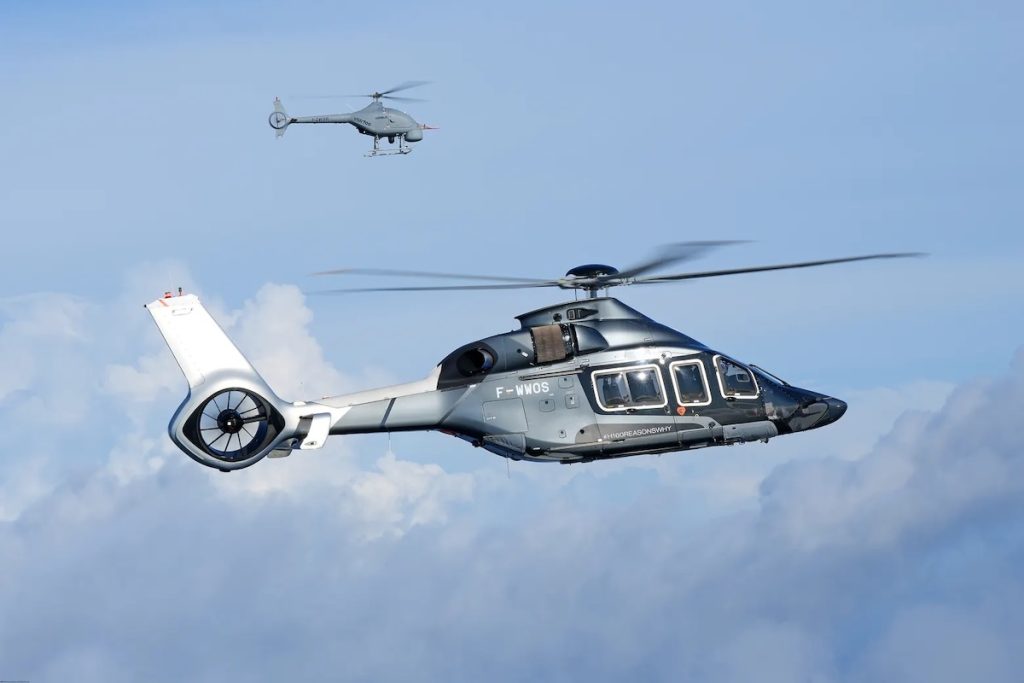
VGR: Overall, our idea is to link our unmanned platforms with our entire range of helicopters with HTeaming, fusing the best of both worlds by using drones to amplify the capability of crewed platforms. We have been working on the crewed-uncrewed teaming concept since 2018 with several demonstrations in Europe aimed at creating a backbone of data link between drones and helicopters. In 2024 we had a European MUSHER demonstration and another in 2025 which paired the Spanish Navy’s H135 with the Flexrotor.
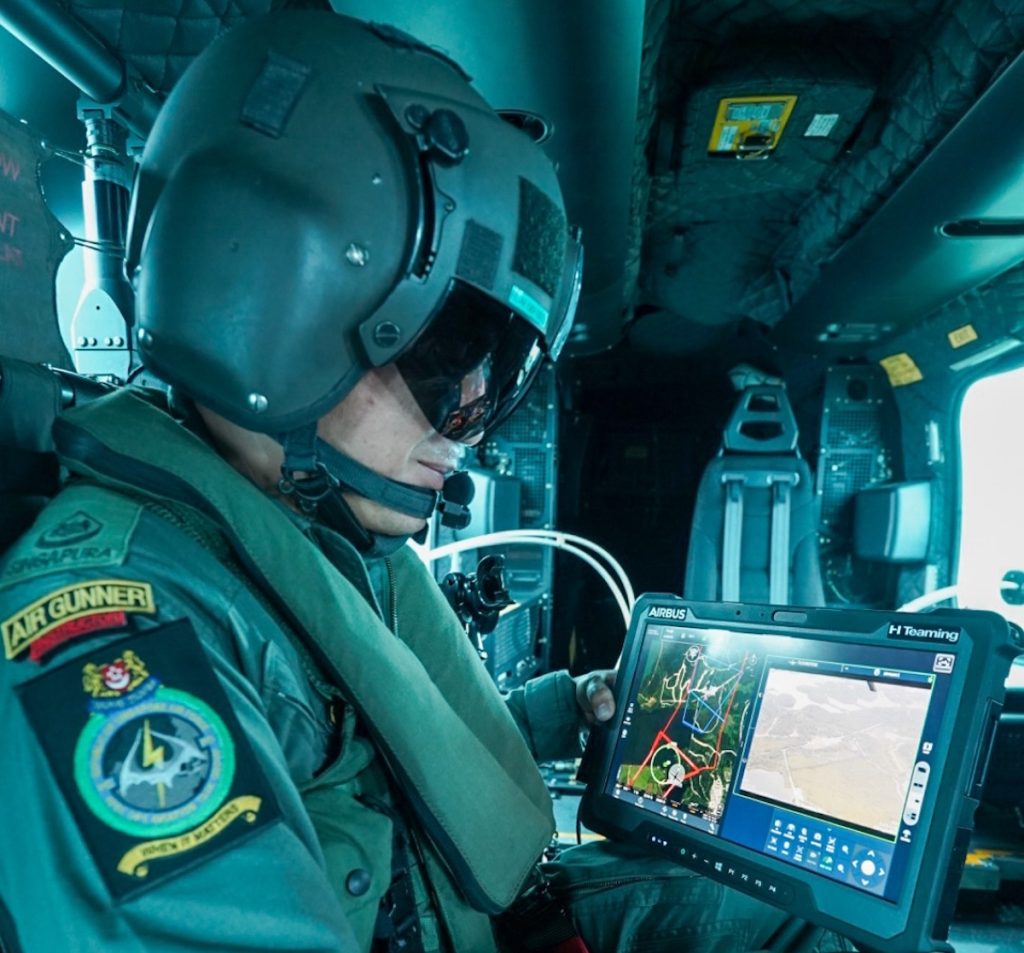
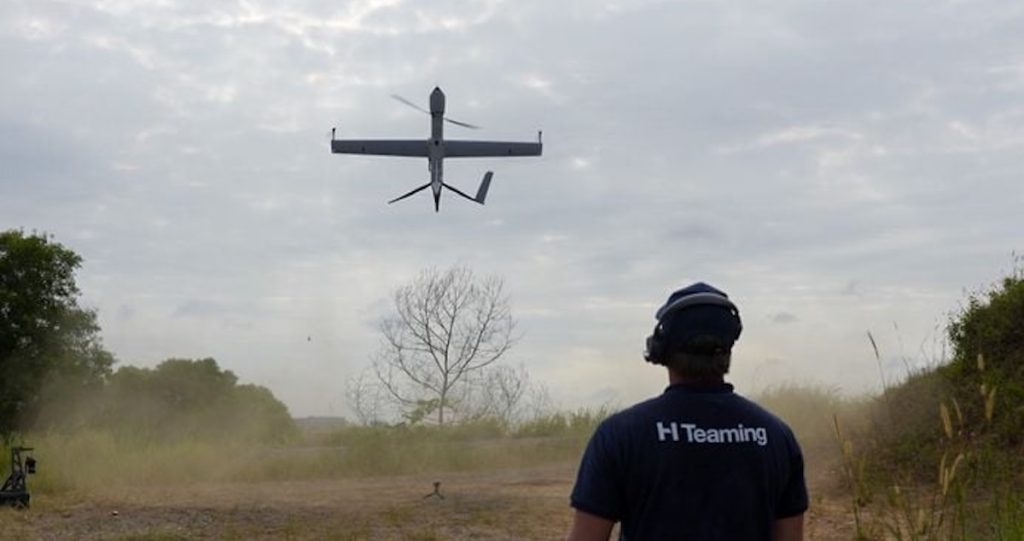
In late January this year, we successfully executed a demonstration between an H225M from the Republic of Singapore Air Force (RSAF) teamed with the Flexrotor. It is a cornerstone for us, an important step because it’s the first joint flight trial performed in real conditions, where a real H225M and Flexrotor actually performed an operational combat search and rescue (CSAR) mission here in Singapore. We began working on this about seven months ago, which is a rather swift time frame in aerospace. Aside from the swift successful realisation of the trial, it is also absolute confirmation that we have the right strategy, not to mention a change in mindset from our customer – the RSAF supported by the Defence Science and Technology Agency (DSTA) and contributing just as much to achieve this feat in such a short time frame.
The RSAF’s H225M was fitted with our HTeaming kit and paired with the Flexrotor that demonstrated the in-flight ability to maintain a solid and stable data link between the helicopter and drone at interoperability level 4, which means we have command and control of the drone’s including its payload and even trajectory. We are not piloting it, but using waypoints by assigning high-level commands. So we are assigning a waypoint to the drone to manage its trajectory and provide it or ask it to perform some pattern to perform surveillance. It was easy to use and easy to interact on just by installing four antennas, some harnesses and a modem, so it was a very low integration effort, and impact on the helicopter. We are extremely thankful for the RSAF and DSTA for their efforts because we really need to work with the customer in order to test these kinds of developments, and that was really instrumental to its success. In terms of what it brings.
This successful trial also completely changes or sets a new concept of operating with a helicopter not as a replacement, but to complement it with a new capability. The possibilities are almost infinite when we see the number of solutions being developed and what the drone can achieve. It opens a complete new world for helicopter operations. The Flexrotor performed reconnaissance ahead of the helicopter, securing the helicopter’s flight path and the downed pilot by discreetly monitoring for potential threats, all while being practically impossible to hear. Our objective is to be able to operate it up to 20 nautical miles ahead of the helicopter as a real-time decision making tool. That way, the personnel onboard do not have to wait for information from ground elements to provide you with situational awareness and such. While the helicopter lands to retrieve the downed pilot, the Flexrotor circled around the helicopter continuously surveilling to ensure that no enemies were arriving. This is important during such rescue missions because helicopters are most vulnerable just before and while it is on the ground. According to the pilot and operators, this is game changing technology for the ways they operate.
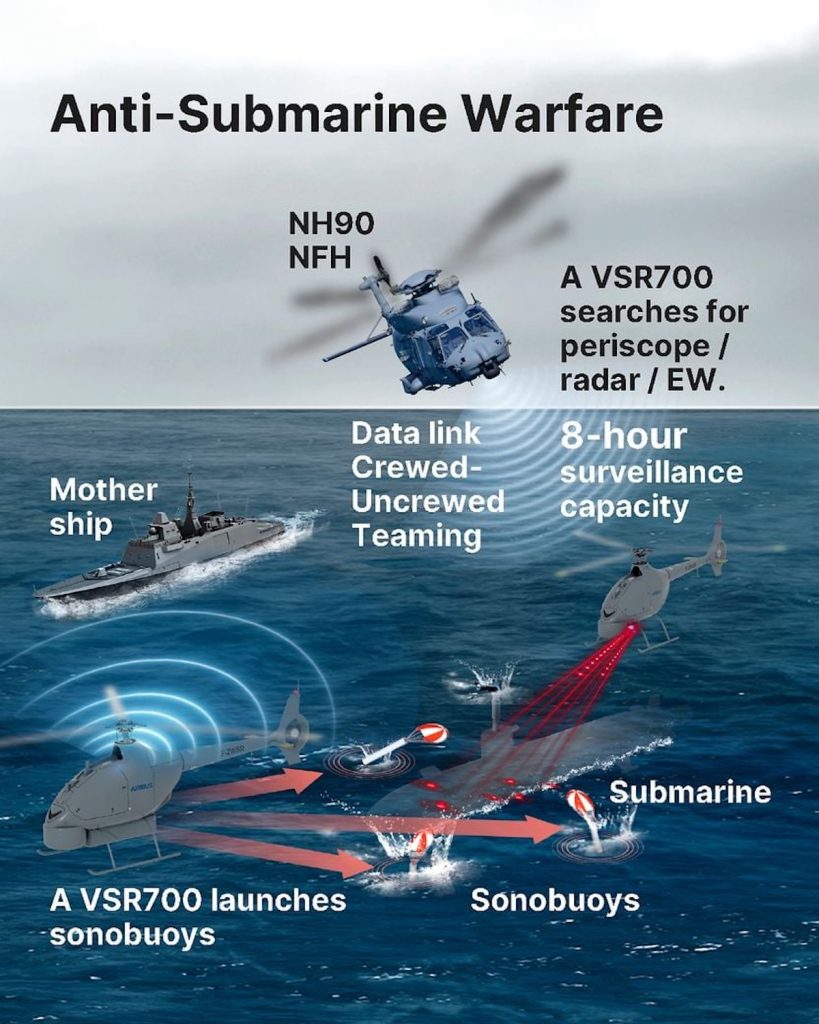
ADJ: With new technological advancements including artificial intelligence (AI), augmented reality and so on, how does Airbus integrate these technologies into developing products and unmanned training solutions?
VGR: So we integrated at different levels, first at the drone level then on the payload side, with automatic object recognition technology being integrated. For HTeaming, one of the bigger objectives that we have focused on achieving is to minimise the crew workload. We do not want the in-flight crew having to manage low level orders for drones. So here the objective is to use artificial intelligence to make the system more powerful and capable of managing drone operations in addition to high value added decision making.
Our short-term goal is to launch products that can interconnect one drone with one helicopter and a safety pilot in the loop. From that point, our mid-term goal would be to couple multiple UAS platforms and helicopters together without the need for remote pilots. The idea is to minimise the pilot workload, because more drones being coupled would typically add more to the pilot’s workload. To do that, we would incorporate some AI in the system to manage a swarm of drones and mission taskings. Subsequently, our long-term goal culminates in multi-domain operations (MDO).