
Shield AI: Protecting Service Members, Civilians With Intelligent Systems
SHIELD AI is a “venture-backed deep-tech” company with the mission of protecting service members and civilians with intelligent systems. Its products include the V-BAT and X-BAT aircraft, Hivemind Enterprise, and the Hivemind Vision product lines. The company’s business development for Asia and the Middle East senior director, Mike Hanlin, speaks to Asian Defence Journal for the Singapore Airshow 2026.
ADJ: Can you tell us more about the latest innovations from Shield AI that will be presented at the Singapore Airshow?
MH: We will be showcasing how we are delivering mission impact worldwide with Hivemind and V-BAT and building the future of autonomous airpower with X-BAT.
Our core software product, Hivemind, is an Artificial Intelligence-enabled mission autonomy software proven across crewed and uncrewed platforms. It allows customers to build, test and deploy autonomy with greater speed, lower cost and reduced integration complexity. Hivemind supports operations in GNSS- and communications-contested environments, enabling platforms to perform dynamic, real-world missions without reliance on external control links. Through Hivemind Enterprise, partners can develop and field intelligent behaviors across multi-domain systems.
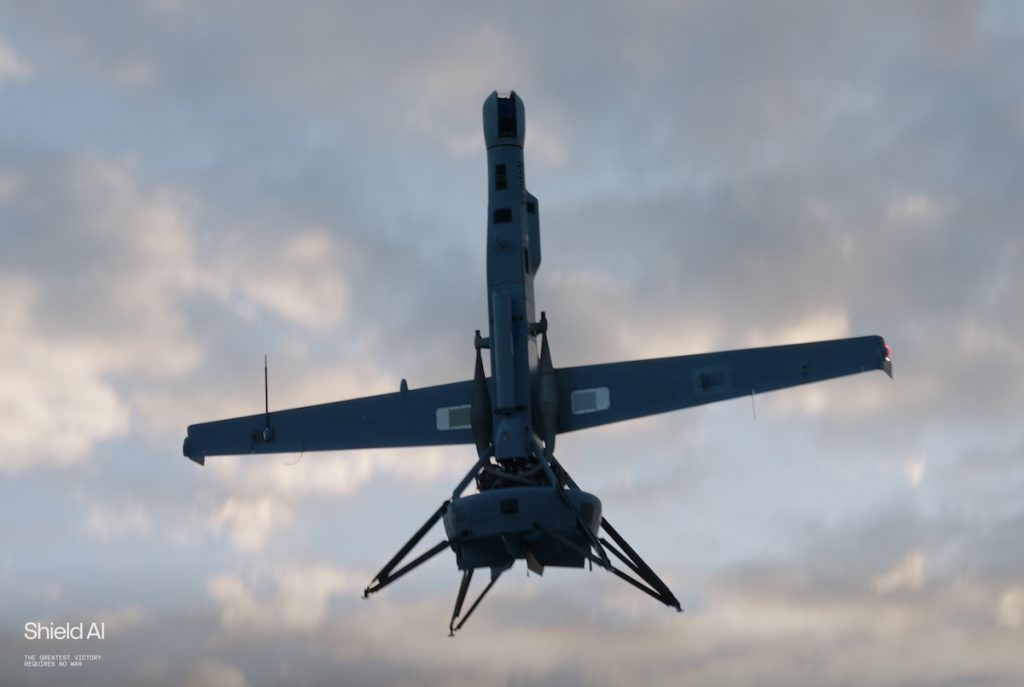
We also offer the Hivemind Vision product line, which delivers AI-enabled wide-area motion imagery (WAMI) for real-time detection and tracking in complex environments. V-BAT, our flagship platform, is a Group 3 single-engine, ducted-fan VTOL UAS with over 12 hours of endurance. Designed, tested and deployed for the electronic warfare battlefield and proven in Ukraine, it delivers combat-proven, expeditionary surveillance and targeting at a fraction of the cost and logistics of larger drones. It launches and recovers without assistance from ship decks, rooftops and austere terrain – no runway, catapult or net required. V-BAT is being adopted by the US Department of War, US Coast Guard, and international customers amid rapidly growing global demand.
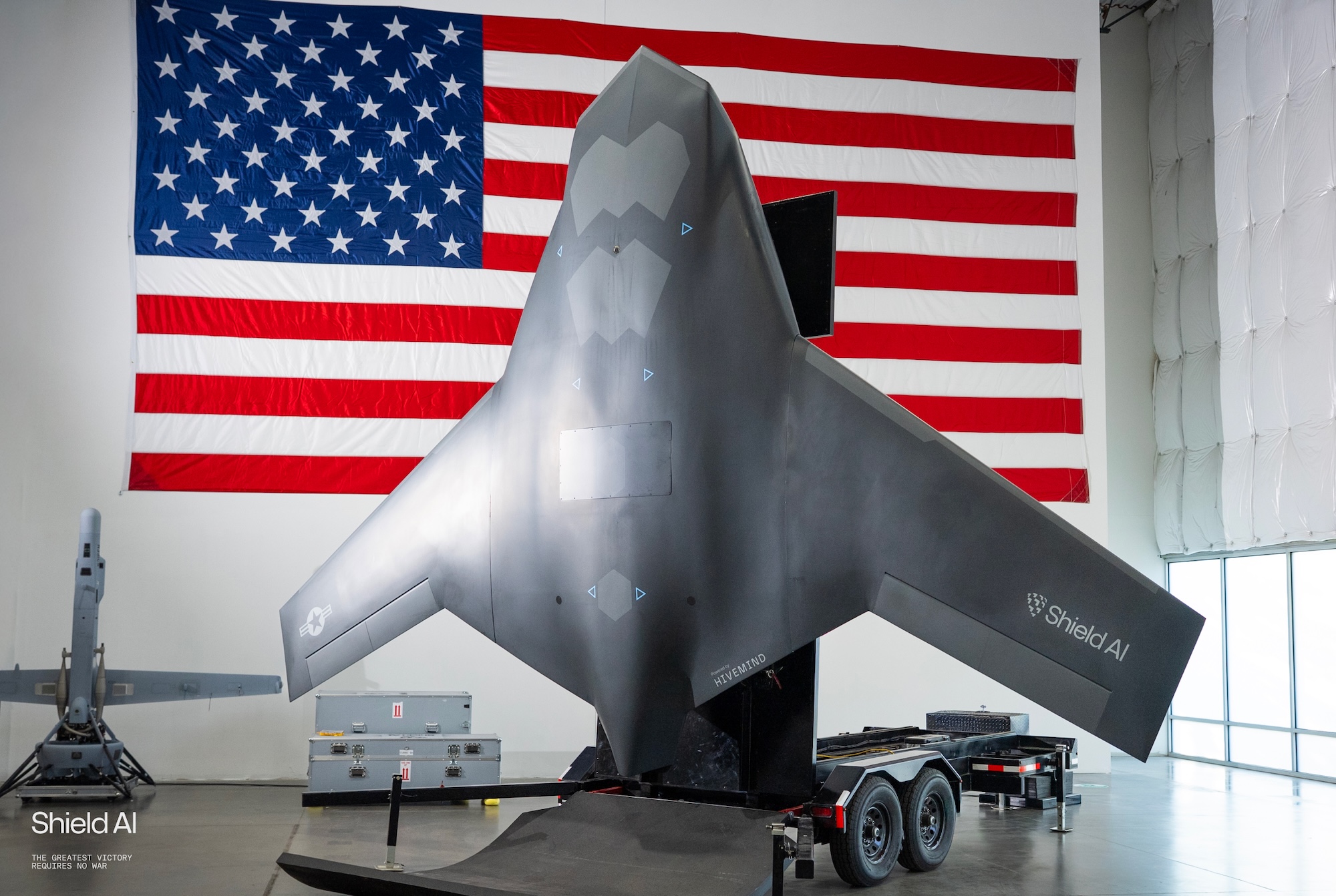
Our newest product, X-BAT is a revolutionary autonomous fighter aircraft, combining VTOL, long range and combat autonomy to break free from legacy constraints like runways and carrier decks. Powered by Hivemind, X-BAT delivers scalable, survivable combat mass in contested environments, operating either independently or as a drone wingman while freeing human aviators for missions that demand judgment. At a fraction of the cost of legacy fighters, with multirole core mission systems and modular payloads, X-BAT gives the US and its allies unmatched flexibility, resilience and deterrence.
ADJ: With the growing use of AI across modern defence and aerospace, how does Shield AI address the challenges of integrating AI into real-world operational environments?
MH: Because we work closely with government and military customers, we have a deep understanding of the complex realities of applying AI in defence environments. Our products are purpose-built to address some of the most critical challenges facing modern forces, operating in denied and contested spaces, reducing risk to service members and increasing operational tempo without increasing manpower. By focusing on real mission needs and impact, we deliver autonomous capabilities that are practical, trusted and operationally effective.
ADJ: How does Shield AI set itself apart within today’s defence and autonomous systems landscape?
MH: Shield AI sets itself apart through demonstrated mission impact. Our systems are already operating in real-world missions where autonomy directly changes outcomes. This impact is evident in Shield AI’s support to the US Coast Guard, where autonomous systems enable persistent maritime surveillance and operations from austere and distributed locations, improving domain awareness without increasing personnel risk. It is also reflected in Ukraine, where V-BATs are being fielded in highly contested environments, proving the value of resilient, software-defined autonomy under real combat conditions. Additionally, Hivemind has now piloted more than 15 different platforms, expanded into the maritime domain, and is on a trajectory to soon extend into space, reflecting its reliability and scalability across domains, platforms and missions. With X-BAT, we are building the world’s first AI-piloted fighter jet, combining VTOL, long range and combat autonomy to deliver a revolutionary aircraft that fulfills critical needs in modern warfare.
ADJ: Can you share more about how Shield AI’s products serve its customers and the key operational challenges they are designed to solve?
MH: Shield AI’s founding and mission, to protect service members and civilians with intelligent systems, is rooted in real-world operational experiences. As a Navy SEAL, Shield AI co-founder Brandon Tseng experienced firsthand problems where intelligent autonomy could have made life-saving differences and set off to bring the best of AI and autonomy technology to the US and our allies to protect service members and civilians. With nearly 20% of its workforce comprising veterans, Shield AI brings a deep understanding of the realities faced on the ground to every product it designs. Shield AI’s products are built with the customer in mind, delivering intelligent, autonomous systems designed to protect service members and expand operational reach in the most demanding and dangerous environments.
V-BAT is already deployed with active service members, providing unmanned intelligence, surveillance and reconnaissance in contested and austere settings where it is either too risky or impractical to send personnel. Hivemind enables true mission autonomy, allowing unmanned systems to perceive, decide, and act with minimal human input. By reducing cognitive load on pilots and operators, Hivemind allows teams to focus on mission objectives rather than vehicle control, while ensuring systems can continue operating when communications or GPS are degraded or denied. We partner directly with Hivemind customers, including the Republic of Singapore Air Force (RSAF), to develop, test and scale sovereign, intelligent mission software capable of operating across both individual unmanned aircraft and coordinated teams. Looking ahead, X-BAT builds on this foundation, extending the same trusted autonomy into new mission sets and operational environments.
ADJ: How does Shield AI incorporate advances in AI and unmanned technology to deliver robust, autonomous solutions for defence applications?
MH: Shield AI continuously integrates advances in AI through a combination of top-tier engineering, rigorous testing and real-world deployment. New capabilities are validated in simulation and operational environments to ensure they improve mission performance, allowing us to deliver autonomy that is reliable, resilient and ready for use in demanding defense applications.