

AUKUS Uncrewed Undersea Vehicles Being Developed
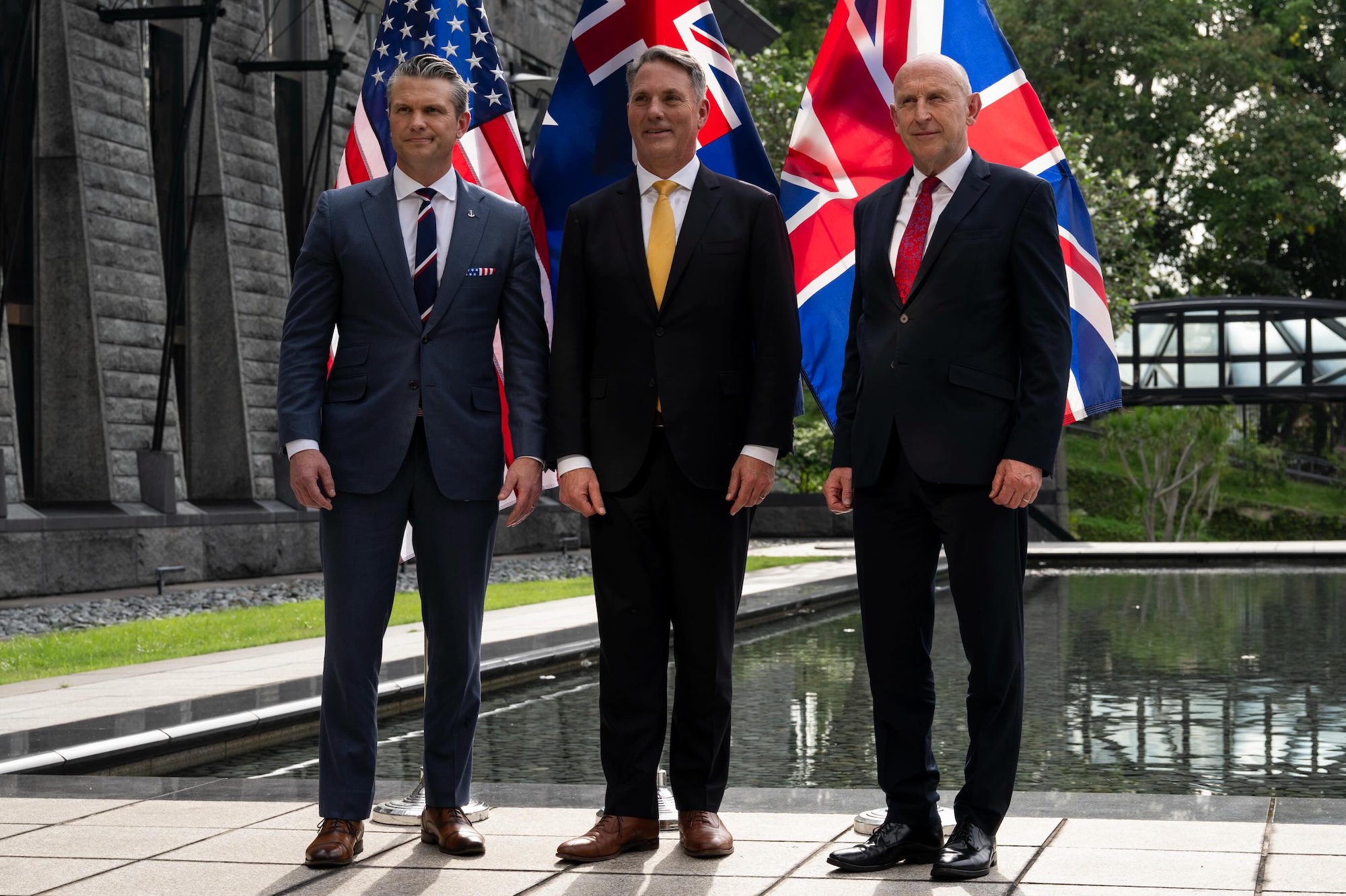
MEETING at the US Embassy in Singapore, AUKUS trio Australian deputy prime minister and defence minister Richard Marles, the US Secretary of War Pete Hegseth and the United Kingdom’s Secretary of State for Defence John Healey re-affirmed their shared commitment to delivering the AUKUS partnership.
Among the projects to be undertaken is the first AUKUS Pillar II Signature Project–developing cutting-edge payloads and enabling systems for AUKUS partners’ Uncrewed Undersea Vehicles (UUVs), with delivery starting in 2027. This project is intended to significantly enhance AUKUS partners’ ability to protect critical national seabed infrastructure, deploy cutting edge surveillance, reconnaissance, and strike capabilities; conduct logistics operations, and bolster superiority in anti-submarine (ASW) and anti-surface warfare (ASuW), mine countermeasures (MCM), electronic warfare (EW), and contested littoral manoeuvre.
Pillar I – Conventionally-Armed, Nuclear-Powered Submarines
Through discussions today, the three chiefs confirmed that AUKUS Pillar I remains on track to support Australia’s acquisition of a conventionally-armed, nuclear-powered submarine capability.
They confirmed key milestones continue to be met for Submarine Rotational Force-West (SRF-West) and announced the finalisation of necessary arrangements for the establishment of SRF-West in 2027. SRF-West will directly support submarine deployments by expanding maintenance options and sustainment infrastructure in the region and will accelerate Australia’s readiness to own, operate, maintain, and regulate a sovereign conventionally-armed, nuclear-powered submarine capability. Just this month, the United States authorised establishment of the US Navy support elements for SRF-West and will begin rotating the first US Navy personnel to HMAS Stirling later this year. Likewise, the United Kingdom reaffirmed its commitment to have a rotational presence as part of SRF-West and noted the successful Submarine Maintenance Period conducted earlier this year by HMS Anson.
The deputy prime minister and Secretaries acknowledged Australia’s planned investments of up to US$5.75 billion at SRF-West for infrastructure and logistics support at HMAS Stirling, along with Australia’s initial down payments of US$2.8B to deliver the new Submarine Construction Yard in South Australia and US$8.6B for the Henderson Defence Precinct—including to support the delivery of contingency docking and depot level maintenance capabilities.
They welcomed the proposed approach to streamline Australia’s acquisition of Virginia-class submarines, simplifying supply chain management, operational and maintenance requirements, and maximising cost efficiencies. This approach would enable Australia to acquire three in-service Virginia-class submarines in lieu of a mixture of new and in-service Virginia-class variants.
Additionally, all three parties acknowledged significant progress in the design and delivery of SSN-AUKUS, which will provide the UK and Australia with an advanced warfighting capability. This progress has been underpinned by investments from both the UK and Australia, including US$8B that the UK committed in 2025.
Pillar II – Advanced Capabilities
They reaffirmed the critical importance of accelerating the delivery of advanced capabilities under AUKUS Pillar II. They announced the first AUKUS Pillar II Signature Project: developing cutting-edge payloads and enabling systems for AUKUS partners’ Uncrewed Undersea Vehicles (UUVs), with delivery starting in 2027. This project is intended to significantly enhance AUKUS partners’ ability to protect critical national seabed infrastructure; deploy cutting edge surveillance, reconnaissance, and strike capabilities; conduct logistics operations; and bolster superiority in anti-submarine and anti-surface warfare, mine countermeasures, electronic warfare, and contested littoral maneuver.
Defence Trade and Industrial Base Collaboration
Hegseth, Marles and Healey confirmed their support for expanding the breadth of the AUKUS licence-free environment between AUKUS partners by taking expeditious and practical steps to narrow the list of excluded technologies. They reaffirmed the value of the Advanced Capabilities Industry Forum and deepening collaboration across the trilateral defence industrial base.